
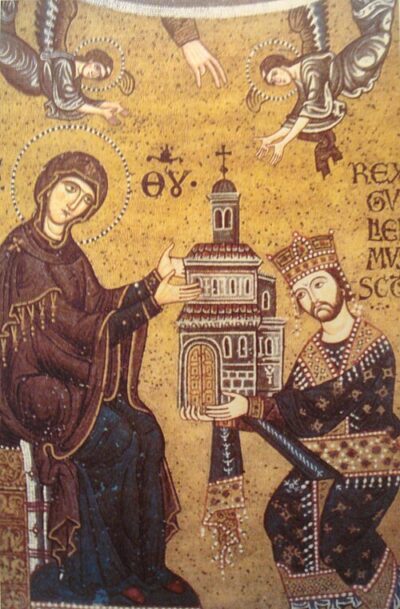
William II of Sicily
William II of Sicily was a King of Sicily. Born 1153, in Palermo. Died November 18, 1189, in Palermo.
Facts
14 facts · 1 confirmed by two sources · 3 cited · 8 from one source · 2 where the sources disagree
What’s different
- Died: we show November 18, 1189 (Sources disagree). Wikipedia says November 11, 1189
- Buried in: we show Cattedrale di Monreale (Sources disagree). Wikidata also lists Palermo Cathedral and Tomb of William II of Sicily
Where this comes from
Papalocal keeps its own record. It started from these sources; what each one said is kept here as it was copied, so a change on their side never changes this page by itself. Tap one to read its version.
What Wikidata says · copied November 16, 2026 · revision 2531190736
- Described as
- King of Sicily
- Other names
- Guglielmo II di Sicilia, Re di Sicilia, William II
- Born
- 1153 · 2 references
- Died
- November 18, 1189 · 1 reference
- Born in
- Palermo
- Died in
- Palermo
- Buried in
- Palermo Cathedral; Cattedrale di Monreale · 2 references; Tomb of William II of Sicily · 1 reference
- Citizen of
- Kingdom of Sicily
- Occupation
- king · 1 reference
- Spouse
- Joan of England (1177–) · 1 reference
- Children
- Bohemond, Duke of Apulia
- Father
- William I of Sicily · 1 reference
- Mother
- Margaret of Navarre · 1 reference
- Siblings
- Roger IV, Duke of Apulia; Robert III, Prince of Capua; Henry, Prince of Capua
- Wikipedias with a page
- 41
Wikidata item Q367387 (wikidata.org/wiki/Q367387), public domain (CC0). Copied November 16, 2026.
What Wikipedia says · copied November 16, 2026 · revision 1347628770
William II (December 1153 – 11 November 1189), called the Good, was king of Sicily from 1166 to 1189. From surviving sources William's character is indistinct. Lacking in military enterprise, secluded and pleasure-loving, he seldom emerged from his palace life at Palermo. Yet his reign is marked by an ambitious foreign policy and a vigorous diplomacy. Champion of the papacy and in secret league with the Lombard cities, he was able to defy the common enemy, Frederick Barbarossa. Recent scholarship has also stressed that the relative stability of William's reign on the mainland rested less on the disappearance of aristocratic power than on a continuing political settlement in which counts, lesser barons, and royal military officers remained central to the governance of Apulia and the Terra di Lavoro. In the Divine Comedy, Dante places William II in Paradise. He is also referred to in Boccaccio's Decameron (tale IV.4, where he reportedly has two children, and tale V.7).
William was nicknamed "the Good" only in the decades following his death. It is due less to his character than to the cessation of the internal troubles that plagued his father's reign and the wars that erupted under his successor. Under the Staufer dynasty his reign was characterised as a golden age of peace and justice. His numeral is contemporary and he himself used it.
- Born, in its opening lines
- December 1153
- Died, in its opening lines
- November 11, 1189
From the Wikipedia article “William II of Sicily” (en.wikipedia.org/wiki/William_II_of_Sicily), by its contributors, under CC BY-SA 4.0 (creativecommons.org/licenses/by-sa/4.0/). Copied November 16, 2026; not changed.
Confirmed Two sources agree. Cited One source, and it names where it got it. One source One source, without a reference of its own. Sources disagree The sources disagree. We show the best-supported value and keep theirs below.
