
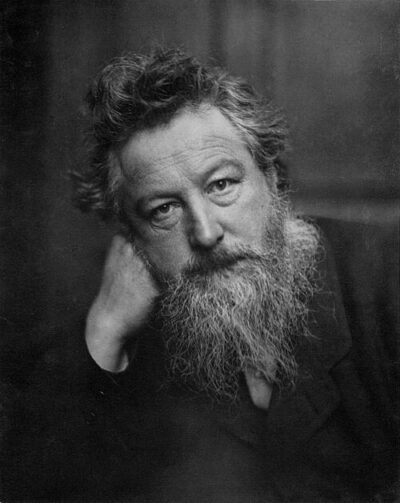
William Morris
William Morris was a textile designer, artist, writer, printer. Born March 24, 1834, in Walthamstow. Died October 3, 1896, in Hammersmith. Known for Red House, A Dream of John Ball and Willow Boughs. Educated at Exeter College and Marlborough College.
Facts
28 facts · 2 confirmed by two sources · 14 cited · 12 from one source
Where this comes from
Papalocal keeps its own record. It started from these sources; what each one said is kept here as it was copied, so a change on their side never changes this page by itself. Tap one to read its version.
What Wikidata says · copied November 16, 2026 · revision 2558283217
- Described as
- textile designer, artist, writer, printer (1834–1896)
- Other names
- William M. Morris, Wiriamu Morisu, Uilʹi︠a︡m Morris, V. Moris
- Born
- March 24, 1834 · 20 references
- Died
- October 3, 1896 · 19 references
- Born in
- Walthamstow · 5 references
- Died in
- Hammersmith · 2 references
- Buried in
- St. George's Churchyard · 1 reference
- Citizen of
- United Kingdom of Great Britain and Ireland; United Kingdom · 2 references
- Occupation
- architect · 3 references; poet · 3 references; designer · 1 reference; graphic designer; painter · 5 references; science fiction writer; politician; illustrator · 2 references
- Political party
- Social Democratic Federation; Socialist League
- Education
- Exeter College (1853–) · 1 reference; Marlborough College · 1 reference
- Genre
- decorative art · 1 reference
- Known for
- Red House; A Dream of John Ball; Willow Boughs; Strawberry Thief
- Spouse
- Jane Morris (1859–) · 2 references
- Children
- May Morris · 1 reference
- Siblings
- Isabella Gilmore
- Website
- https://williammorrissociety.org/
- Wikipedias with a page
- 78
Wikidata item Q182589 (wikidata.org/wiki/Q182589), public domain (CC0). Copied November 16, 2026.
What Wikipedia says · copied November 16, 2026 · revision 1385859417
William Morris (24 March 1834 – 3 October 1896) was an English textile designer, poet, artist, writer, and socialist activist associated with the British Arts and Crafts movement. He was a major contributor to the revival of traditional British textile arts and methods of production. His literary contributions helped to establish the modern fantasy genre, while he campaigned for socialism in fin de siècle Great Britain.
Morris was born in Walthamstow, Essex, to a wealthy middle-class family. He came under the strong influence of medievalism while studying classics at Oxford University, where he joined the Birmingham Set. After university, he married Jane Burden, and developed close friendships with Pre-Raphaelite artists and poets such as Dante Gabriel Rossetti, Algernon Charles Swinburne, and Edward Burne-Jones, as well as with Neo-Gothic architect Philip Webb. Webb and Morris designed Red House in Kent where Morris lived from 1859 to 1865, before moving to Bloomsbury, central London. In 1861, Morris founded the Morris, Marshall, Faulkner & Co. decorative arts firm with Burne-Jones, Rossetti, Webb, and others, which became highly fashionable and much in demand. The firm profoundly influenced interior decoration throughout the Victorian period, with Morris designing tapestries, wallpaper, fabrics, furniture, and stained glass windows. In 1875, he assumed total control of the company, which was renamed Morris & Co.
From 1871, Morris rented the rural retreat of Kelmscott Manor, Oxfordshire, while also retaining a main home in London. He was greatly influenced by visits to Iceland with Eiríkur Magnússon, and he produced a series of English-language translations of Icelandic Sagas. He also achieved success with the publication of his epic poems and novels, namely The Earthly Paradise (1868–1870), A Dream of John Ball (1888), the utopian News from Nowhere (1890), and the fantasy romance The Well at the World's End (1896). In 1877, he founded the Society for the Protection of Ancient Buildings to campaign against the damage caused by architectural restoration. Through the influence of medievalism and Christian socialism in the 1850s he became a sceptic of industrial capitalism. After reading works of Henry George, Alfred Russel Wallace, and Karl Marx in the 1880s Morris became a committed revolutionary socialist activist until his final acceptance of parliamentary socialism in 1896. He founded the Socialist League in 1884 after an involvement in the Social Democratic Federation (SDF), but he broke with that organization in 1890. In 1891, he founded the Kelmscott Press to publish limited-edition, illuminated-style print books, a cause to which he devoted his final years.
Morris is recognized as one of the most significant cultural figures of Victorian Britain. He was best known in his lifetime for his poetry, although he posthumously became better known for his designs. The William Morris Society, founded in 1955, is devoted to his legacy, while multiple biographies and studies of his work have been published. Many of the buildings associated with his life are open to visitors, much of his work can be found in art galleries and museums, and his designs are still in production.
- Born, in its opening lines
- March 24, 1834
- Died, in its opening lines
- October 3, 1896
From the Wikipedia article “William Morris” (en.wikipedia.org/wiki/William_Morris), by its contributors, under CC BY-SA 4.0 (creativecommons.org/licenses/by-sa/4.0/). Copied November 16, 2026; not changed.
Confirmed Two sources agree. Cited One source, and it names where it got it. One source One source, without a reference of its own. Sources disagree The sources disagree. We show the best-supported value and keep theirs below.
