
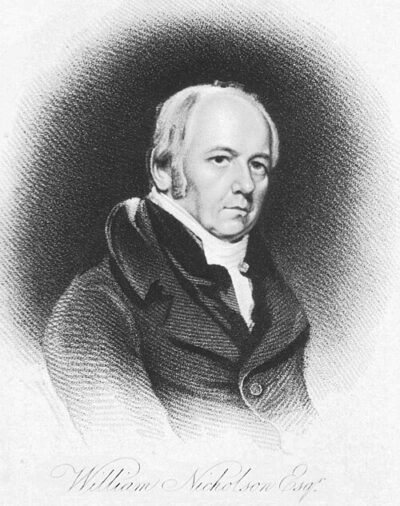
William Nicholson
William Nicholson was a British chemist. Born December 13, 1753, in London. Died May 21, 1815, in Bloomsbury.
Facts
15 facts · 2 confirmed by two sources · 5 cited · 8 from one source
Where this comes from
Papalocal keeps its own record. It started from these sources; what each one said is kept here as it was copied, so a change on their side never changes this page by itself. Tap one to read its version.
What Wikidata says · copied November 18, 2026 · revision 2565592625
- Described as
- British chemist (1753-1815)
- Born
- December 13, 1753 · 1 reference
- Died
- May 21, 1815 · 4 references
- Born in
- London · 2 references
- Died in
- Bloomsbury · 1 reference
- Citizen of
- United Kingdom of Great Britain and Ireland · 1 reference
- Occupation
- chemist · 2 references; journalist; philosopher; lawyer; physicist; translator; writer; mathematician · 1 reference
- Member of
- Bavarian Academy of Sciences and Humanities; Royal Netherlands Academy of Arts and Sciences · 1 reference
- Wikipedias with a page
- 23
Wikidata item Q695200 (wikidata.org/wiki/Q695200), public domain (CC0). Copied November 18, 2026.
What Wikipedia says · copied November 18, 2026 · revision 1374670776
William Nicholson (13 December 1753 – 21 May 1815) was an English writer, translator, publisher, scientist, inventor, patent agent and civil engineer. He launched the first monthly scientific journal in Britain, Journal of Natural Philosophy, Chemistry, and the Arts, in 1797, and remained its editor until 1814. In 1800, he and Anthony Carlisle were the first to achieve electrolysis, the splitting of water into hydrogen and oxygen, using a voltaic pile. Nicholson also wrote extensively on natural philosophy and chemistry.
- Born, in its opening lines
- December 13, 1753
- Died, in its opening lines
- May 21, 1815
From the Wikipedia article “William Nicholson (chemist)” (en.wikipedia.org/wiki/William_Nicholson_(chemist)), by its contributors, under CC BY-SA 4.0 (creativecommons.org/licenses/by-sa/4.0/). Copied November 18, 2026; not changed.
Confirmed Two sources agree. Cited One source, and it names where it got it. One source One source, without a reference of its own. Sources disagree The sources disagree. We show the best-supported value and keep theirs below.
