
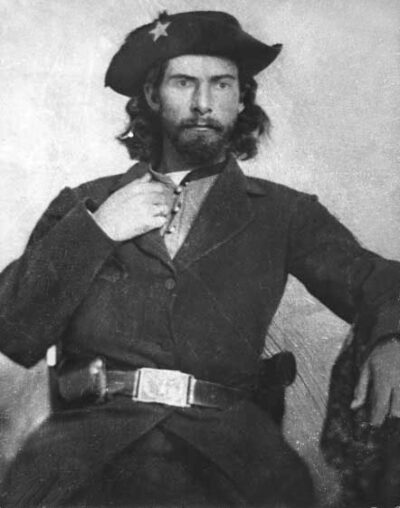
William T. Anderson
William T. Anderson was an American guerrilla fighter. Born 1839, in Hopkins County. Died October 27, 1864, in Ray County.
Facts
11 facts · 0 confirmed by two sources · 2 cited · 7 from one source · 2 where the sources disagree
What’s different
- Born: we show 1839 (Sources disagree). Wikipedia says c. 1840
- Died: we show October 27, 1864 (Sources disagree). Wikipedia says October 26, 1864
Where this comes from
Papalocal keeps its own record. It started from these sources; what each one said is kept here as it was copied, so a change on their side never changes this page by itself. Tap one to read its version.
What Wikidata says · copied November 16, 2026 · revision 2508573463
- Described as
- American guerrilla fighter (1839–1864)
- Born
- 1839 · 1 reference
- Died
- October 27, 1864 · 2 references
- Born in
- Hopkins County
- Died in
- Ray County
- Buried in
- Pioneer Cemetery · 1 reference
- Citizen of
- United States
- Occupation
- military personnel; gangster; partisan · 1 reference
- Military branch
- Quantrill's Raiders
- Military rank
- captain · 1 reference
- Wikipedias with a page
- 20
Wikidata item Q717758 (wikidata.org/wiki/Q717758), public domain (CC0). Copied November 16, 2026.
What Wikipedia says · copied November 16, 2026 · revision 1379824268
William T. Anderson (c. 1840 – October 26, 1864), known by the nickname "Bloody Bill" Anderson, was a Confederate soldier who was one of the deadliest and most notorious guerrilla leaders in the American Civil War. Anderson led a band of volunteer partisan raiders who targeted Union loyalists and federal soldiers in the states of Missouri and Kansas.
Raised by a family of Southerners in Kansas, Anderson began to support himself by stealing and selling horses in 1862. After a former friend and secessionist turned Union loyalist judge killed his father, Anderson killed the judge and fled to Missouri. There he robbed travelers and killed several Union soldiers. In early 1863 he joined Quantrill's Raiders, a group of Confederate guerrillas which operated along the Kansas–Missouri border. He became a skilled bushwhacker, earning the trust of the group's leaders, William Quantrill and George M. Todd. Anderson's bushwhacking marked him as a dangerous man and eventually led the Union to imprison his sisters. After a building collapse in the makeshift jail in Kansas City, Missouri killed one sister and left another permanently maimed, Anderson devoted himself to revenge. He took a leading role in the Lawrence Massacre and later took part in the Battle of Baxter Springs, both in 1863.
In late 1863, while Quantrill's Raiders spent the winter in Sherman, Texas, animosity developed between Anderson and Quantrill. Anderson made allegations implicating Quantrill in a murder, leading to the latter's arrest by Confederate authorities. Anderson subsequently returned to Missouri as the leader of his own group of raiders and became the most feared guerrilla in the state, robbing and killing a large number of Union soldiers and civilian sympathizers. Although Union supporters viewed him as incorrigibly evil, Confederate supporters in Missouri saw his actions as justifiable. In September 1864, Anderson led a raid on the town of Centralia, Missouri. Unexpectedly, his men were able to capture a passenger train, the first time Confederate guerrillas had done so. In what became known as the Centralia Massacre, Anderson's bushwhackers killed 24 unarmed Union soldiers on the train and set an ambush later that day which killed over a hundred Union soldiers. Anderson himself was killed a month later in battle. Historians have made disparate appraisals of Anderson; some see him as a sadistic, psychopathic killer, while others put his actions into the perspective of the general desperation and lawlessness of the time and the brutalizing effect of war.
- Born, in its opening lines
- c. 1840
- Died, in its opening lines
- October 26, 1864
From the Wikipedia article “William T. Anderson” (en.wikipedia.org/wiki/William_T._Anderson), by its contributors, under CC BY-SA 4.0 (creativecommons.org/licenses/by-sa/4.0/). Copied November 16, 2026; not changed.
Confirmed Two sources agree. Cited One source, and it names where it got it. One source One source, without a reference of its own. Sources disagree The sources disagree. We show the best-supported value and keep theirs below.
