
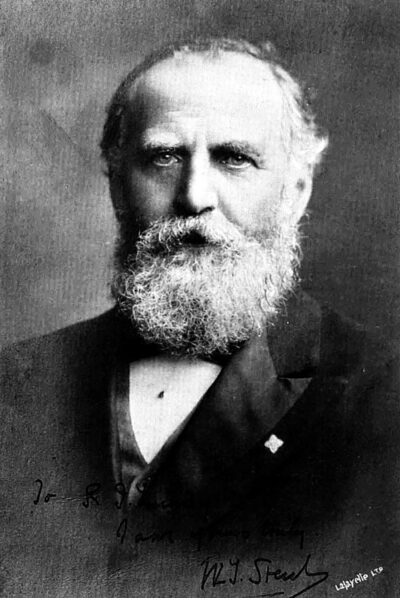
William Thomas Stead
William Thomas Stead was an English newspaper editor. Born July 5, 1849, in Northumberland. Died April 15, 1912, in North Atlantic Ocean. Positions held include editor-in-chief. Educated at Silcoates School.
Facts
19 facts · 2 confirmed by two sources · 7 cited · 10 from one source
Where this comes from
Papalocal keeps its own record. It started from these sources; what each one said is kept here as it was copied, so a change on their side never changes this page by itself. Tap one to read its version.
What Wikidata says · copied November 16, 2026 · revision 2567456292
- Described as
- English newspaper editor (1849–1912)
- Other names
- William Stead, William T. Stead
- Born
- July 5, 1849 · 6 references
- Died
- April 15, 1912 · 6 references
- Born in
- Northumberland · 1 reference
- Died in
- North Atlantic Ocean · 2 references
- Buried in
- North Shields
- Cause of death
- drowning · 1 reference
- Citizen of
- United Kingdom of Great Britain and Ireland; United Kingdom
- Occupation
- writer · 1 reference; journalist · 1 reference; Esperantist; journal editor; opinion journalist · 1 reference; peace movement · 1 reference
- Positions held
- editor-in-chief
- Education
- Silcoates School
- Children
- Estelle W. Stead
- Father
- William Stead
- Siblings
- Francis Herbert Stead
- Wikipedias with a page
- 42
Wikidata item Q288301 (wikidata.org/wiki/Q288301), public domain (CC0). Copied November 16, 2026.
What Wikipedia says · copied November 16, 2026 · revision 1383727669
William Thomas Stead (5 July 1849 – 15 April 1912) was an English newspaper editor who, as a pioneer of investigative journalism, became a controversial figure of the Victorian era. Stead published a series of hugely influential campaigns whilst editor of The Pall Mall Gazette, including his 1885 series of articles, The Maiden Tribute of Modern Babylon. These were written in support of a bill, later dubbed the "Stead Act", that raised the age of consent from 13 to 16.
Stead's "new journalism" paved the way for the modern tabloid in Great Britain. He has been described as "the most famous journalist in the British Empire". He is considered to have influenced how the press could be used to influence public opinion and government policy, and advocated "Government by Journalism". He was known for his reportage on child welfare, social legislation and reformation of England's criminal codes.
Stead died in the sinking of the RMS Titanic.
- Born, in its opening lines
- July 5, 1849
- Died, in its opening lines
- April 15, 1912
From the Wikipedia article “W. T. Stead” (en.wikipedia.org/wiki/W._T._Stead), by its contributors, under CC BY-SA 4.0 (creativecommons.org/licenses/by-sa/4.0/). Copied November 16, 2026; not changed.
Confirmed Two sources agree. Cited One source, and it names where it got it. One source One source, without a reference of its own. Sources disagree The sources disagree. We show the best-supported value and keep theirs below.
