
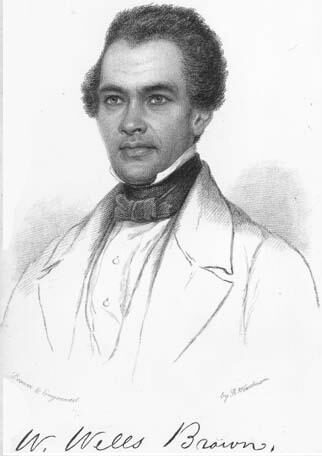
William Wells Brown
William Wells Brown was an American abolitionist lecturer, novelist, playwright, and historian. Born November 6, 1814, in Lexington. Died November 6, 1884, in Chelsea.
Facts
14 facts · 2 confirmed by two sources · 6 cited · 6 from one source
Where this comes from
Papalocal keeps its own record. It started from these sources; what each one said is kept here as it was copied, so a change on their side never changes this page by itself. Tap one to read its version.
What Wikidata says · copied November 18, 2026 · revision 2568066712
- Described as
- American abolitionist lecturer, novelist, playwright, and historian (1814–1884)
- Other names
- William Brown
- Born
- November 6, 1814 · 1 reference
- Died
- November 6, 1884 · 4 references
- Born in
- Lexington · 1 reference
- Died in
- Chelsea · 1 reference
- Buried in
- Cambridge Cemetery · 1 reference
- Citizen of
- France; United States
- Occupation
- writer · 1 reference; historian; novelist; playwright · 1 reference; abolitionist
- Worked for
- The St. Louis Times · 1 reference
- Children
- Josephine Brown
- Wikipedias with a page
- 17
Wikidata item Q961244 (wikidata.org/wiki/Q961244), public domain (CC0). Copied November 18, 2026.
What Wikipedia says · copied November 18, 2026 · revision 1382850679
William Wells Brown (November 6, 1814 – November 6, 1884) was an American abolitionist, novelist, playwright, and historian. Born into slavery near Mount Sterling, Kentucky, Brown escaped to Ohio in 1834 at the age of 19. He settled in Boston, Massachusetts, where he worked for abolitionist causes and became a prolific writer. While working for abolition, Brown also supported causes including: temperance, women's suffrage, pacifism, prison reform, and an anti-tobacco movement. He was a member of Prince Hall Freemasonry. His novel Clotel (1853), considered the first novel written by an African American, was published in London, England, where he resided at the time. It was later published in the United States.
Brown was a pioneer in several different literary genres, including travel writing, fiction, and drama. In 1858 he became the first published African-American playwright, and often read from this work on the lecture circuit. Following the Civil War, in 1867 he published what is considered the first history of African Americans in the Revolutionary War. He was among the first writers inducted to the Kentucky Writers Hall of Fame, established in 2013. A public school was named for him in Lexington, Kentucky.
Brown was lecturing in England when the 1850 Fugitive Slave Law was passed in the US. As its provisions increased the risk of his capture and re-enslavement, even in northern states, he stayed overseas for several years. He traveled throughout Europe. After his freedom was purchased in 1854 by a British couple, he and his two daughters returned to the US, where he rejoined the abolitionist lecture circuit in the North. A contemporary of Frederick Douglass, Brown was overshadowed by the charismatic orator and the two feuded publicly.
- Born, in its opening lines
- November 6, 1814
- Died, in its opening lines
- November 6, 1884
From the Wikipedia article “William Wells Brown” (en.wikipedia.org/wiki/William_Wells_Brown), by its contributors, under CC BY-SA 4.0 (creativecommons.org/licenses/by-sa/4.0/). Copied November 18, 2026; not changed.
Confirmed Two sources agree. Cited One source, and it names where it got it. One source One source, without a reference of its own. Sources disagree The sources disagree. We show the best-supported value and keep theirs below.
