
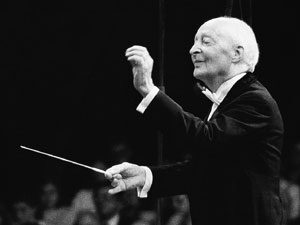
Witold Lutosławski
Witold Lutosławski was a Polish composer and conductor. Born January 25, 1913, in Warsaw. Died February 7, 1994, in Warsaw. Known for Symphony No. 1, Mi-Parti and Symphony No. 3. Educated at Chopin University of Music and Stefan Batory Gymnasium and Lyceum. Awards include Knight of the Order of Polonia Restituta, Herder Prize and Order of the White Eagle.
Facts
42 facts · 2 confirmed by two sources · 7 cited · 33 from one source
Where this comes from
Papalocal keeps its own record. It started from these sources; what each one said is kept here as it was copied, so a change on their side never changes this page by itself. Tap one to read its version.
What Wikidata says · copied November 16, 2026 · revision 2563757373
- Described as
- Polish composer and conductor (1913-1994)
- Born
- January 25, 1913 · 15 references
- Died
- February 7, 1994 · 14 references
- Born in
- Warsaw · 2 references
- Died in
- Warsaw · 2 references
- Buried in
- Powązki Cemetery · 1 reference
- Citizen of
- Poland
- Occupation
- composer · 2 references; conductor · 2 references; musicologist; pianist; music teacher · 1 reference; musician · 1 reference
- Education
- Chopin University of Music; Stefan Batory Gymnasium and Lyceum
- Member of
- Academy of Arts of the GDR; Academy of Arts, Berlin; Bavarian Academy of Fine Arts; Serbian Academy of Sciences and Arts; Union of Polish Composers · 1 reference; Académie des beaux-arts
- Genre
- classical music
- Instrument
- violin; piano
- Record label
- Deutsche Grammophon
- Known for
- Symphony No. 1; Mi-Parti; Symphony No. 3
- Awards
- Knight of the Order of Polonia Restituta; Herder Prize (1967); Order of the White Eagle; Medal of the 10th Anniversary of People's Poland; Pour le Mérite for Sciences and Arts order; Léonie Sonning Music Prize (1967); Royal Philharmonic Society Gold Medal (1986); Order of the Builders of People's Poland; Medal of the 30th Anniversary of People's Poland; honorary doctor of Durham University (1983); honorary doctor of the Jagiellonian University of Krakow (1984); honorary doctor of the University of Warsaw (1973); honorary doctorate from the University of Cambridge (1987); Wihuri Sibelius Prize (1973); Work Flag Order, 1st class
- Wikipedias with a page
- 48
Wikidata item Q156472 (wikidata.org/wiki/Q156472), public domain (CC0). Copied November 16, 2026.
What Wikipedia says · copied November 16, 2026 · revision 1371964179
Witold Roman Lutosławski (Polish: [ˈvitɔlt lutɔˈswafskʲi] ; 25 January 1913 – 7 February 1994) was a Polish composer and conductor. Among the major composers of 20th-century classical music, he is "generally regarded as the most significant Polish composer since Szymanowski, and possibly the greatest Polish composer since Chopin". His compositions—of which he was a notable conductor—include representatives of most traditional genres, aside from opera: symphonies, concertos, orchestral song cycles, other orchestral works, and chamber works. Among his best known works are his four symphonies, the Variations on a Theme by Paganini (1941), the Concerto for Orchestra (1954), and his cello concerto (1970).
During his youth, Lutosławski studied piano and composition in Warsaw. His early works were influenced by Polish folk music and demonstrated a wide range of rich atmospheric textures. His folk-inspired music includes the Concerto for Orchestra (1954)—which first brought him international renown—and Dance Preludes (1955), which he described as a "farewell to folklore". From the late 1950s he began developing new, characteristic composition techniques. He introduced limited aleatoric elements, while retaining tight control of his music's material, architecture, and performance. He also evolved his practice of building harmonies from small groups of musical intervals.
During World War II, after narrowly escaping German capture, Lutosławski made a living playing the piano in Warsaw bars. After the war, Stalinist authorities banned his First Symphony for being "formalist": accessible only to an elite. Rejecting anti-formalism as an unjustified retrograde step, Lutosławski resolutely strove to maintain his artistic integrity, providing artistic support to the Solidarity movement throughout the 1980s. He received numerous awards and honours, including the Grawemeyer Award and a Royal Philharmonic Society Gold Medal. In 1994, Lutosławski was awarded Poland's highest honour, the Order of the White Eagle.
- Born, in its opening lines
- January 25, 1913
- Died, in its opening lines
- February 7, 1994
From the Wikipedia article “Witold Lutosławski” (en.wikipedia.org/wiki/Witold_Lutosławski), by its contributors, under CC BY-SA 4.0 (creativecommons.org/licenses/by-sa/4.0/). Copied November 16, 2026; not changed.
Confirmed Two sources agree. Cited One source, and it names where it got it. One source One source, without a reference of its own. Sources disagree The sources disagree. We show the best-supported value and keep theirs below.
