
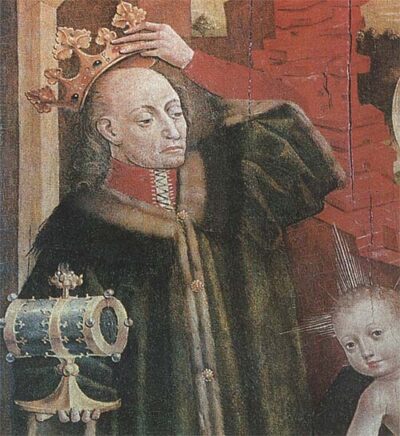
Władysław II Jagiełło
Władysław II Jagiełło was a King of Poland and Grand Duke of Lithuania. Born 1362, in Vilnius. Died June 1, 1434, in Jagiellonian Gord. Positions held include King of Poland (1386–1434).
Facts
31 facts · 0 confirmed by two sources · 5 cited · 26 from one source
Where this comes from
Papalocal keeps its own record. It started from these sources; what each one said is kept here as it was copied, so a change on their side never changes this page by itself. Tap one to read its version.
What Wikidata says · copied November 16, 2026 · revision 2568891940
- Described as
- King of Poland and Grand Duke of Lithuania (1362-1434)
- Other names
- Jogaila, Vladislav II, Vladislav II of Poland
- Born
- 1362
- Died
- June 1, 1434 · 2 references
- Born in
- Vilnius
- Died in
- Jagiellonian Gord
- Buried in
- Wawel Cathedral
- Citizen of
- Grand Duchy of Lithuania · 1 reference; Kingdom of Poland · 1 reference
- Occupation
- politician
- Positions held
- King of Poland (1386–1434)
- Spouse
- Jadwiga I of Poland (1386–) · 4 references; Anna of Cilli (1402–1416); Elizabeth Granowska (1417–1420); Sophia of Halshany (1422–1434) · 2 references
- Children
- Elizabeth Bonifacia of Poland; Hedwig Jagiellon; Władysław III of Poland · 2 references; Casimir IV Jagiellon
- Father
- Algirdas · 3 references
- Mother
- Uliana of Tver · 2 references
- Siblings
- Agrypina of Lithuania; Alexandra of Lithuania; Švitrigaila / Svidrigiello · 1 reference; Lengvenis; Kaributas; Demetrius I Starshy; Karigaila; Feodor Olgerdovich; Vygantas · 1 reference; Skirgaila
- Religion
- Catholicism (1386–) · 1 reference; Lithuanian mythology · 1 reference
- Wikipedias with a page
- 76
Wikidata item Q54049 (wikidata.org/wiki/Q54049), public domain (CC0). Copied November 16, 2026.
What Wikipedia says · copied November 16, 2026 · revision 1385450347
Jogaila (Lithuanian: [jɔˈɡâːɪɫɐ] ; c. 1352/1362 – 1 June 1434), later Władysław II Jagiełło (Polish: [vwaˈdɨswaf jaˈɡʲɛwwɔ] ), was Grand Duke of Lithuania beginning in 1377 and King of Poland from 1386 until his death. As Grand Duke, he ruled Lithuania from 1377 to 1381 and from 1382 to 1401, at which time he became the Supreme Duke of Lithuania in exchange for naming his cousin Vytautas as the new Grand Duke. Władysław II initially served as King of Poland alongside his wife Jadwiga until her death in 1399, and then the sole ruler until his own death in 1434.
Raised a Lithuanian polytheist, he converted to Catholicism in 1386 and baptized as Ladislaus (Polish: Władysław) in Kraków, married the young Queen Jadwiga, and was crowned King of Poland as Władysław II Jagiełło. In 1387, he converted Lithuania to Catholicism. His sole reign in Poland started in 1399, upon the death of Queen Jadwiga, lasted a further thirty-five years, and laid the foundation for the centuries-long Polish–Lithuanian union. He was a member of the Jagiellonian dynasty in Poland that bears his name and was previously also known as the Gediminid dynasty in the Grand Duchy of Lithuania. The dynasty ruled both states until 1572, and became one of the most influential dynasties in late medieval and early modern Europe.
Jogaila was the last pagan ruler of medieval Lithuania. After he became King of Poland, as a result of the Union of Krewo, the newly formed Polish-Lithuanian union confronted the growing power of the Teutonic Order. The allied victory at the Battle of Grunwald in 1410, followed by the Peace of Thorn, secured the Polish and Lithuanian borders and marked the emergence of the Polish–Lithuanian alliance as a significant force in Europe. The reign of Władysław II Jagiełło extended Polish frontiers and is often considered the beginning of Poland's Golden Age.
From the Wikipedia article “Władysław II Jagiełło” (en.wikipedia.org/wiki/Władysław_II_Jagiełło), by its contributors, under CC BY-SA 4.0 (creativecommons.org/licenses/by-sa/4.0/). Copied November 16, 2026; not changed.
Confirmed Two sources agree. Cited One source, and it names where it got it. One source One source, without a reference of its own. Sources disagree The sources disagree. We show the best-supported value and keep theirs below.
