
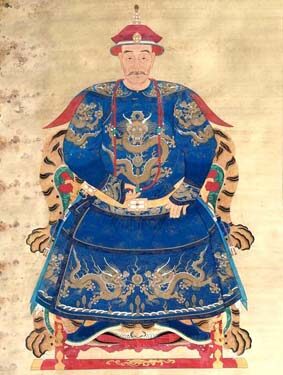
Wu Sangui was a Chinese general and rebel. Born 1612, in Suizhong County. Died October 2, 1678, in Hengyang. Positions held include emperor (1678).
Facts
16 facts · 2 confirmed by two sources · 2 cited · 12 from one source
Where this comes from
Papalocal keeps its own record. It started from these sources; what each one said is kept here as it was copied, so a change on their side never changes this page by itself. Tap one to read its version.
What Wikidata says · copied November 16, 2026 · revision 2553830175
- Described as
- Chinese general and rebel (1612-1678)
- Other names
- Changbai, Anfuyuan, Changbo, Ng Sam Kwai
- Born
- 1612 · 4 references
- Died
- October 2, 1678 · 1 reference
- Born in
- Suizhong County
- Died in
- Hengyang
- Cause of death
- dysentery
- Citizen of
- Qing dynasty · 1 reference; Ming dynasty; Zhou dynasty (1678–1681)
- Occupation
- military leader; monarch
- Positions held
- emperor (1678)
- Spouse
- Empress Zhang; Chen Yuanyuan · 1 reference
- Children
- Wu Yingxiong
- Father
- Wu Xiang
- Military rank
- general · 1 reference
- Wikipedias with a page
- 30
Wikidata item Q468701 (wikidata.org/wiki/Q468701), public domain (CC0). Copied November 16, 2026.
What Wikipedia says · copied November 16, 2026 · revision 1371664481
Wu Sangui (Chinese: 吳三桂; pinyin: Wú Sānguì; Wade–Giles: Wu San-kuei; 8 June 1612 – 2 October 1678), courtesy name Changbai (長白) or Changbo (長伯), was a Chinese military leader who played a key role in the fall of the Ming dynasty and the founding of the Qing dynasty. In Chinese folklore, Wu Sangui is regarded as a disreputable Han Chinese traitor for his defection over to the Manchu invaders, suppression of the Southern Ming resistance and execution of the Yongli Emperor. Wu eventually double-crossed both of his masters, the Ming and the Qing dynasties.
In 1644, Wu was a Ming general in charge of garrisoning Shanhai Pass, the strategic choke point between Manchuria and Beijing. After learning that Li Zicheng's rebel army had conquered Beijing and captured his family, including his father Wu Xiang and concubine Chen Yuanyuan, Wu allowed the Manchu to enter China proper through Shanhai Pass to drive Li from Beijing, where the Manchu then set up the Qing dynasty. For his aid, the Qing rulers awarded him a fiefdom consisting of Yunnan and Guizhou provinces, along with the title "Prince Who Pacifies the West" (平西王).
In 1674, Wu decided to rebel against the Qing. In 1678, Wu declared himself the new Emperor of China and the ruler of Zhou, only to die within months. For a time, his grandson Wu Shifan succeeded him. The revolt was quelled in 1681.
- Born, in its opening lines
- June 8, 1612
- Died, in its opening lines
- October 2, 1678
From the Wikipedia article “Wu Sangui” (en.wikipedia.org/wiki/Wu_Sangui), by its contributors, under CC BY-SA 4.0 (creativecommons.org/licenses/by-sa/4.0/). Copied November 16, 2026; not changed.
Confirmed Two sources agree. Cited One source, and it names where it got it. One source One source, without a reference of its own. Sources disagree The sources disagree. We show the best-supported value and keep theirs below.
