
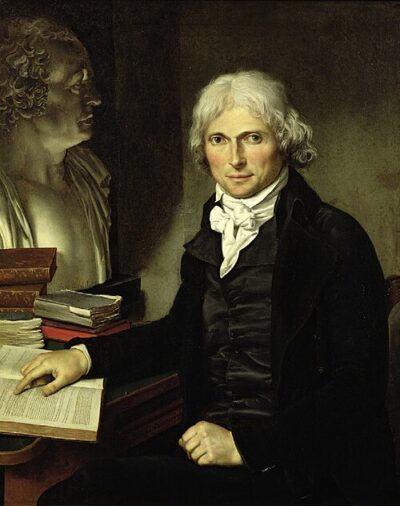
Xavier Bichat
Xavier Bichat was a French anatomist and pathologist. Born November 14, 1771, in Thoirette. Died July 22, 1802, in Paris. Awards include 72 names on the Eiffel Tower.
Facts
18 facts · 2 confirmed by two sources · 5 cited · 10 from one source · 1 where the sources disagree
What’s different
- Buried in: we show Père Lachaise Cemetery (Sources disagree). Wikidata also lists Grave of Xavier Bichat
Where this comes from
Papalocal keeps its own record. It started from these sources; what each one said is kept here as it was copied, so a change on their side never changes this page by itself. Tap one to read its version.
What Wikidata says · copied November 16, 2026 · revision 2564333784
- Described as
- French anatomist and pathologist (1771–1802)
- Other names
- Xav. Bichat, Marie François Xavier Bichât, Marie François Xavier Bichat
- Born
- November 14, 1771 · 7 references
- Died
- July 22, 1802 · 11 references
- Born in
- Thoirette
- Died in
- Paris · 2 references
- Buried in
- Père Lachaise Cemetery · 1 reference; Grave of Xavier Bichat
- Cause of death
- typhoid fever · 1 reference
- Name at birth
- Marie François Xavier Bichat
- Citizen of
- France
- Occupation
- anatomist; physician · 1 reference; pathologist; surgeon; physiologist · 1 reference
- Member of
- Société Philomathique de Paris
- Awards
- 72 names on the Eiffel Tower · 1 reference
- Field
- anatomical pathology; histology; medicine · 1 reference
- Wikipedias with a page
- 49
Wikidata item Q333489 (wikidata.org/wiki/Q333489), public domain (CC0). Copied November 16, 2026.
What Wikipedia says · copied November 16, 2026 · revision 1384134334
Marie François Xavier Bichat (; French: [ɡzavje biʃa]; 14 November 1771 – 22 July 1802) was a French anatomist and pathologist, known as the father of modern histology. Although he worked without a microscope, Bichat distinguished 21 types of elementary tissues from which the organs of the human body are composed. He was also "the first to propose that tissue is a central element in human anatomy, and he considered organs as collections of often disparate tissues, rather than as entities in themselves". The buccal fat pad (also called Bichat’s fat pad) was named after him.
Although Bichat was "hardly known outside the French medical world" at the time of his early death, forty years later "his system of histology and pathological anatomy had taken both the French and English medical worlds by storm." The Bichatian tissue theory was "largely instrumental in the rise to prominence of hospital doctors" as opposed to empiric therapy, as "diseases were now defined in terms of specific lesions in various tissues, and this lent itself to a classification and a list of diagnoses".
- Born, in its opening lines
- November 14, 1771
- Died, in its opening lines
- July 22, 1802
From the Wikipedia article “Xavier Bichat” (en.wikipedia.org/wiki/Xavier_Bichat), by its contributors, under CC BY-SA 4.0 (creativecommons.org/licenses/by-sa/4.0/). Copied November 16, 2026; not changed.
Confirmed Two sources agree. Cited One source, and it names where it got it. One source One source, without a reference of its own. Sources disagree The sources disagree. We show the best-supported value and keep theirs below.
