
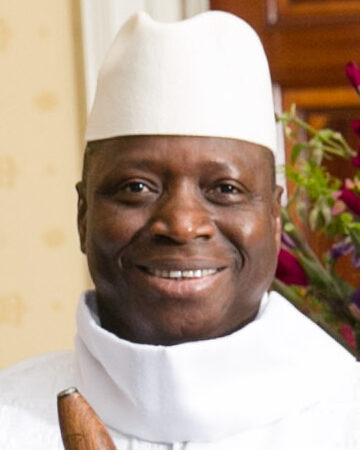
Yahya Jammeh
Yahya Jammeh is the 2nd President of the Gambia. Born May 25, 1965, in Kanilai. Positions held include President of the Gambia (1996–2017). Educated at Western Hemisphere Institute for Security Cooperation. Awards include Order of the Republic of The Gambia, National Order of the Lion of Senegal and Order of Brilliant Jade.
Facts
21 facts · 1 confirmed by two sources · 4 cited · 16 from one source
Where this comes from
Papalocal keeps its own record. It started from these sources; what each one said is kept here as it was copied, so a change on their side never changes this page by itself. Tap one to read its version.
What Wikidata says · copied November 16, 2026 · revision 2558286206
- Described as
- 2nd President of the Gambia
- Other names
- Yahya Abdul-Aziz Jemus Junkung Jammeh
- Born
- May 25, 1965 · 3 references
- Born in
- Kanilai
- Name at birth
- Yahya Abdul-Aziz Jemus Junkung Jammeh
- Citizen of
- The Gambia
- Occupation
- politician; military officer; serial rapist · 3 references; healer · 1 reference
- Positions held
- President of the Gambia (1996–2017)
- Political party
- Alliance for Patriotic Reorientation and Construction
- Education
- Western Hemisphere Institute for Security Cooperation
- Awards
- Order of the Republic of The Gambia; National Order of the Lion of Senegal; Order of Brilliant Jade
- Spouse
- Zeineb Jammeh · 1 reference; Tuti Faal · 1 reference
- Mother
- Asombi Bojang
- Religion
- Sunni Islam
- Military rank
- colonel
- Lived in
- Mongomo (2017–)
- Website
- http://www.statehouse.gm/president.html
- Wikipedias with a page
- 69
Wikidata item Q57356 (wikidata.org/wiki/Q57356), public domain (CC0). Copied November 16, 2026.
What Wikipedia says · copied November 16, 2026 · revision 1384705657
Yahya Abdul-Aziz Jemus Junkung Jammeh (born 25 May 1965) is a Gambian politician and former soldier, who served as President of the Gambia from 1996 to 2017. He was the Chairman of the Armed Forces Provisional Ruling Council (AFPRC) from 1994 to 1996.
Jammeh was born in Kanilai, in West Coast Region of the Gambia, and is a Muslim of the Jola ethnic group. He attended Gambia High School in Banjul from 1978 to 1983 and served in the Gambian National Gendarmerie from 1984 to 1989. He was then commissioned as an officer of the Gambian National Army, commanding the Military Police from 1992 to 1994. In July 1994, he came to power by leading a bloodless coup d'état that overthrew the elected government of Sir Dawda Jawara. At first ruling by decree, he was elected president in the 1996 election. Jammeh was re-elected as president in 2001, 2006 and 2011, but lost to Adama Barrow in 2016.
His presidency oversaw a shift towards authoritarianism, demonstrated in particular by his policies towards anti-government journalists, LGBT+ people and opposition parties. His foreign policy led to constant difficulties with the country's sole neighbour, Senegal. In 2013, Jammeh withdrew the Gambia from the Commonwealth of Nations and in 2016 he began the process of withdrawing the country from the International Criminal Court, one year after he declared the nation an Islamic republic. All three decisions were later rescinded by his successor's government, despite Jammeh's supporters arguing that his foreign policy encouraged self-sufficiency and anti-colonialism.
Jammeh has been implicated in serious human rights violations, such as murder, rape and torture, as highlighted in the final report of the Truth, Reconciliation and Reparations Commission. He is now living in exile in Equatorial Guinea. His assets around the world have been frozen by many countries amidst additional accusations of stealing millions of dollars from his country to fund a life of luxury. Jammeh has denied the allegations against him and has not been formally charged.
- Born, in its opening lines
- May 25, 1965
From the Wikipedia article “Yahya Jammeh” (en.wikipedia.org/wiki/Yahya_Jammeh), by its contributors, under CC BY-SA 4.0 (creativecommons.org/licenses/by-sa/4.0/). Copied November 16, 2026; not changed.
Confirmed Two sources agree. Cited One source, and it names where it got it. One source One source, without a reference of its own. Sources disagree The sources disagree. We show the best-supported value and keep theirs below.
