
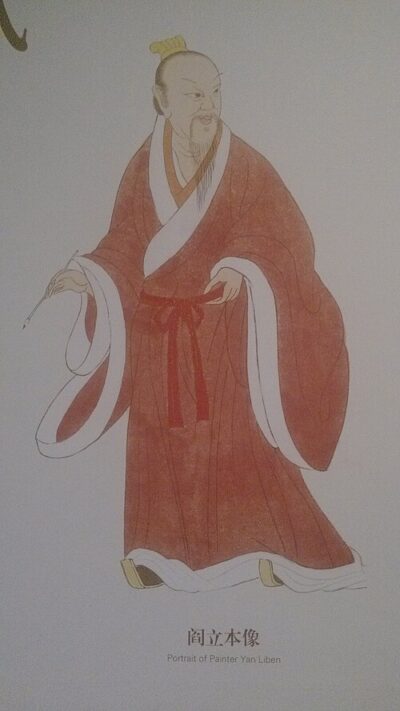
Yan Liben
Yan Liben was a Tang dynasty painter (c. 600-673). Born 600, in Chang'an. Died 673. Positions held include Chancellor of the Tang dynasty. Known for Bunian Tu.
Facts
18 facts · 2 confirmed by two sources · 9 cited · 7 from one source
Where this comes from
Papalocal keeps its own record. It started from these sources; what each one said is kept here as it was copied, so a change on their side never changes this page by itself. Tap one to read its version.
What Wikidata says · copied November 18, 2026 · revision 2567280295
- Described as
- Tang dynasty painter (c. 600-673)
- Other names
- Wenzhen
- Born
- 600; 600 · 1 reference
- Died
- 673 · 3 references
- Born in
- Chang'an
- Citizen of
- Tang dynasty · 1 reference
- Occupation
- painter · 2 references; architect · 1 reference; civil servant · 1 reference; poet; court official · 1 reference; calligrapher · 1 reference
- Positions held
- Chancellor of the Tang dynasty
- Genre
- portrait
- Known for
- Bunian Tu
- Children
- Yan Kejian · 1 reference; Yan Jiabin · 1 reference
- Father
- Yan Pi · 1 reference
- Mother
- Princess Qingdou
- Siblings
- Yan Lide
- Wikipedias with a page
- 22
Wikidata item Q721435 (wikidata.org/wiki/Q721435), public domain (CC0). Copied November 18, 2026.
What Wikipedia says · copied November 18, 2026 · revision 1372174608
Yan Liben (Chinese: 閻立本; pinyin: Yán Lìběn; Wade–Giles: Yen Li-pen; c. 600 – 14 November 673), posthumous name Baron Wenzhen of Boling (博陵文貞男), was a Chinese architect, painter, and politician during the early Tang dynasty. His most famous work, possibly the only genuine survival, is the Thirteen Emperors Scroll. He also painted the Portraits at Lingyan Pavilion, under Emperor Taizong of Tang, commissioned in 643 to commemorate 24 of the greatest contributors to Emperor Taizong's reign, as well as 18 portraits commemorating the 18 great scholars who served Emperor Taizong when he was the Prince of Qin. Yan's paintings included painted portraits of various Chinese emperors from the Han dynasty (202 BC–220 AD) up until the Sui dynasty (581–618) period. His works were highly regarded by the Tang writers Zhu Jingxuan and Zhang Yanyuan, who noted his paintings were "works among the glories of all times".
From the years 669 to 673, Yan Liben also served as a chancellor under Emperor Taizong's son Emperor Gaozong (r. 649–683).A record of 1120 gives 42 titles of Yan's paintings, though the Thirteen Emperors Scroll is not among them. Only four Buddhist subjects are listed, against 12 Daoist. The remainder are portraits, "gods of the planets and constellations" or records of events at court. Of the surviving works attributed to him, the Thirteen Emperors Scroll is "the first that is generally accepted as being partly original", though much of it seems later. A similar figure of an emperor in fresco in the Mogao Caves (Cave 200), might be by the same hand, and carries the appropriate date of 642.
By tradition the reliefs of the six favourite horses at the mausoleum of Emperor Taizong (d. 649) were designed by Yan Liben, and the relief is so flat and linear that it seems likely they were carved after drawings or paintings. Yan Liben is documented as producing other works for the tomb, a portrait series that is now lost, and perhaps designed the whole structure.
- Born, in its opening lines
- c. 600
- Died, in its opening lines
- November 14, 673
From the Wikipedia article “Yan Liben” (en.wikipedia.org/wiki/Yan_Liben), by its contributors, under CC BY-SA 4.0 (creativecommons.org/licenses/by-sa/4.0/). Copied November 18, 2026; not changed.
Confirmed Two sources agree. Cited One source, and it names where it got it. One source One source, without a reference of its own. Sources disagree The sources disagree. We show the best-supported value and keep theirs below.
