
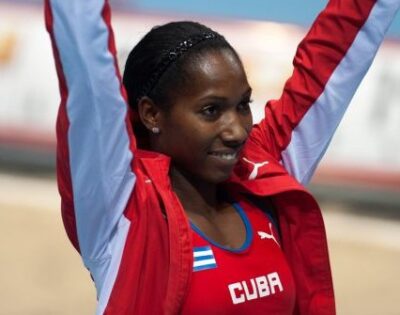
Yarisley Silva is a Cuban pole vaulter. Born June 1, 1987, in San Luis.
Facts
7 facts · 1 confirmed by two sources · 1 cited · 5 from one source
Where this comes from
Papalocal keeps its own record. It started from these sources; what each one said is kept here as it was copied, so a change on their side never changes this page by itself. Tap one to read its version.
What Wikidata says · copied November 16, 2026 · revision 2568846452
- Described as
- Cuban pole vaulter
- Other names
- Yarisley Silva Rodríguez, Yarisley Silva Rodriguez
- Born
- June 1, 1987 · 1 reference
- Born in
- San Luis
- Citizen of
- Cuba
- Occupation
- pole vaulter; athletics competitor · 1 reference
- Sport
- athletics
- Height
- 1.61 m (5 ft 3 in)
- Wikipedias with a page
- 29
Wikidata item Q6312 (wikidata.org/wiki/Q6312), public domain (CC0). Copied November 16, 2026.
What Wikipedia says · copied November 16, 2026 · revision 1381201290
Yarisley Silva Rodríguez (born 1 June 1987) is a Cuban pole vaulter. She won the silver medal at the 2012 Summer Olympics – the first Latin American athlete to win an Olympic medal in that event.
Silva became the first Cuban woman to reach a world class standard in the pole vault. Her personal bests of 4.90 m (16 ft 3⁄4 in) outdoors and 4.78 m (15 ft 8 in) indoors are the Cuban and Central American and Caribbean records for the event.
She emerged at the regional level with a silver medal at the 2006 Central American and Caribbean Games, and a bronze medal at the 2007 Pan American Games. She then won gold medals at the 2009 Central American and Caribbean Championships in Athletics and the 2011 Pan American Games.
Silva represented Cuba at the 2008 Summer Olympics and came fifth at the 2011 World Championships in Athletics.
- Born, in its opening lines
- June 1, 1987
From the Wikipedia article “Yarisley Silva” (en.wikipedia.org/wiki/Yarisley_Silva), by its contributors, under CC BY-SA 4.0 (creativecommons.org/licenses/by-sa/4.0/). Copied November 16, 2026; not changed.
Confirmed Two sources agree. Cited One source, and it names where it got it. One source One source, without a reference of its own. Sources disagree The sources disagree. We show the best-supported value and keep theirs below.
