
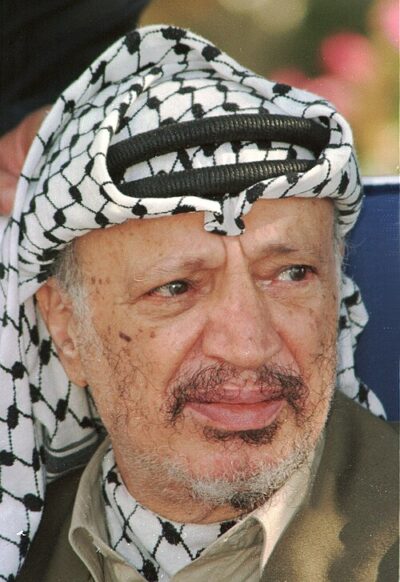
Yasser Arafat
Yasser Arafat was a Palestinian political leader (1929-2004) and Former President of the Palestinian National Authority. Born August 4, 1929, in Cairo. Died November 11, 2004, in Hôpital d'instruction des armées Percy. Positions held include Chairman of the Executive Committee of the Palestine Liberation Organization (1969–2004), President of the Palestinian National Authority (1994–2004) and president of the State of Palestine (1989–2004). Educated at Cairo University. Awards include Knight Grand Cross with Collar of the Order of Merit of the Italian Republic, Nobel Peace Prize and Jawaharlal Nehru Award for International Understanding.
Facts
43 facts · 2 confirmed by two sources · 9 cited · 31 from one source · 1 where the sources disagree
What’s different
- Cause of death: we show cerebral hemorrhage (Sources disagree). Wikidata also lists autoimmune thrombocytopenic purpura
Where this comes from
Papalocal keeps its own record. It started from these sources; what each one said is kept here as it was copied, so a change on their side never changes this page by itself. Tap one to read its version.
What Wikidata says · copied November 16, 2026 · revision 2568393585
- Described as
- Palestinian political leader (1929-2004) and Former President of the Palestinian National Authority (1994-2004)
- Other names
- Yaser Arafat, Yassir Arafat, Mohammed Yasser Abdel Rahman Abdel Raouf Arafat al-Qudwa al-Husseini, Muhammad Yassur Abd ar-Raouf Arafat al-Qudwa, Abu Ammar, Mohammed Yasser Abdel Rahman Abdel Raouf Arafat al-Qudwa, Yasir Arafat
- Born
- August 4, 1929 · 3 references
- Died
- November 11, 2004 · 10 references
- Born in
- Cairo · 2 references
- Died in
- Hôpital d'instruction des armées Percy · 1 reference
- Buried in
- Mukataa Ramallah
- Cause of death
- cerebral hemorrhage; autoimmune thrombocytopenic purpura
- Name at birth
- محمد ياسر عبد الرحمن عبد الرؤوف عرفات
- Citizen of
- Palestine
- Occupation
- politician · 2 references; civil engineer; freedom fighter · 1 reference; engineer · 1 reference
- Positions held
- Chairman of the Executive Committee of the Palestine Liberation Organization (1969–2004); President of the Palestinian National Authority (1994–2004); president of the State of Palestine (1989–2004); Minister of Education of the Palestinian National Authority (1996–1998)
- Political party
- Fatah
- Education
- Cairo University (1944–1950)
- Awards
- Knight Grand Cross with Collar of the Order of Merit of the Italian Republic (1999) · 1 reference; Nobel Peace Prize (1994) · 2 references; Jawaharlal Nehru Award for International Understanding (1988) · 1 reference; Félix Houphouët-Boigny Peace Prize (1993); Princess of Asturias Award for International Cooperation; Doublespeak Award (1975); Grand Collar of the Order of Good Hope (1998) · 1 reference; Order of Prince Yaroslav the Wise, 1st class (1999); Order of Playa Girón; honorary doctor of the University of Patras · 1 reference; Order of the Republic; Order of Ouissam Alaouite; Grand cross of the Order of the White Lion; Knight Grand Cordon with Collar of the Order of Palestine (2018); Order of Palestine · 1 reference
- Spouse
- Suha Arafat (1990–2004) · 1 reference
- Father
- Abdel Raouf al-Qudwa al-Husseini
- Mother
- Zahwa Abul Saud
- Siblings
- Khadija Arafat; Fathi Arafat; Jamal Arafat
- Religion
- Sunni Islam
- Military rank
- commander-in-chief
- Lived in
- Al-Maghariba Quarter · 1 reference; Mukataa Ramallah
- Wikipedias with a page
- 155
Wikidata item Q34211 (wikidata.org/wiki/Q34211), public domain (CC0). Copied November 16, 2026.
What Wikipedia says · copied November 16, 2026 · revision 1385791269
Yasser Arafat (c. August 1929 – 11 November 2004), also popularly known by his kunya Abu Ammar, was a Palestinian political leader. He was chairman of the Palestine Liberation Organization (PLO) from 1969 to 2004, President of Palestine from 1989 to 2004 and President of the Palestinian Authority (PNA) from 1994 to 2004. Ideologically an Arab nationalist and a socialist, Arafat was a founding member of the Fatah political party, which he led from 1959 until 2004.
Arafat was born to Palestinian parents in Cairo, Egypt, where he spent most of his youth. He studied at the University of King Fuad I. While a student, he embraced Arab nationalist and anti-Zionist ideas. Opposed to the 1948 creation of the State of Israel, he fought alongside the Muslim Brotherhood during the 1948 Arab–Israeli War. Following the defeat of Arab forces, Arafat returned to Cairo and served as president of the General Union of Palestinian Students from 1952 to 1956.
In the latter part of the 1950s, Arafat co-founded Fatah, a paramilitary organization which sought Israel's replacement with a Palestinian state. Fatah operated within several Arab countries, from where it launched attacks on Israeli targets. In the latter part of the 1960s Arafat's profile grew; in 1967 he joined the Palestinian Liberation Organization (PLO) and in 1969 was elected chair of the Palestinian National Council (PNC). Fatah's growing presence in Jordan resulted in military clashes with King Hussein's Jordanian government and in the early 1970s it relocated to Lebanon. There, Fatah assisted the Lebanese National Movement during the Lebanese Civil War and continued its attacks on Israel, resulting in the organization becoming a major target of Israeli invasions during the 1978 South Lebanon conflict and 1982 Lebanon War.
From 1983 to 1993, Arafat based himself in Tunisia, and began to shift his approach from open conflict with the Israelis to negotiation. In 1988, he acknowledged Israel's right to exist and sought a two-state solution to the Israeli–Palestinian conflict. In 1994, he returned to Palestine, settling in Gaza City and promoting self-governance for the Palestinian territories. He engaged in a series of negotiations with the Israeli government to end the conflict between it and the PLO. These included the Madrid Conference of 1991, the 1993 Oslo Accords and the 2000 Camp David Summit. The success of the negotiations in Oslo led to Arafat being awarded the Nobel Peace Prize, alongside Israeli prime ministers Yitzhak Rabin and Shimon Peres, in 1994. At the time, Fatah's support among the Palestinians declined with the growth of Hamas and other militant rivals. In late 2004, after effectively being confined within his Ramallah compound for over two years by the Israeli army, Arafat fell into a coma and died. The cause of Arafat's death remains the subject of speculation. Investigations by Russian and French teams determined no foul play was involved, while a Swiss team determined he was radiologically poisoned.
Arafat remains a controversial figure. Palestinians generally view him as a martyr who symbolized the national aspirations of his people, while many Israelis regarded him as a terrorist. Palestinian rivals, including Islamists and several PLO radicals, frequently denounced him as corrupt or too submissive in his concessions to the Israeli government.
- Born, in its opening lines
- August 1929
- Died, in its opening lines
- November 11, 2004
From the Wikipedia article “Yasser Arafat” (en.wikipedia.org/wiki/Yasser_Arafat), by its contributors, under CC BY-SA 4.0 (creativecommons.org/licenses/by-sa/4.0/). Copied November 16, 2026; not changed.
Confirmed Two sources agree. Cited One source, and it names where it got it. One source One source, without a reference of its own. Sources disagree The sources disagree. We show the best-supported value and keep theirs below.
