
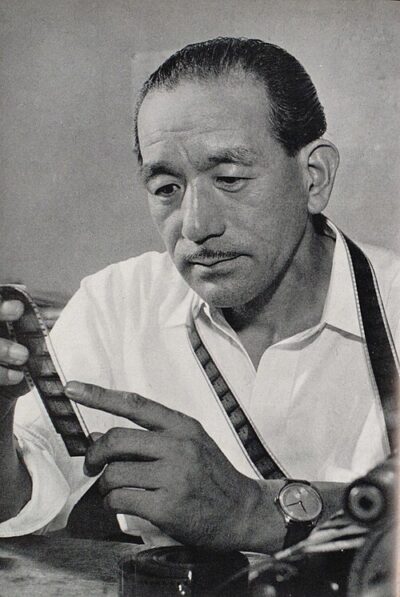
Yasujirō Ozu
Yasujirō Ozu was a Japanese film director, screenwriter. Born December 12, 1903, in Fukagawa-ku. Died December 12, 1963, in Institute of Science Tokyo Hospital. Known for Equinox Flower and Late Spring. Educated at Waseda University. Awards include Blue Ribbon Awards for Best Director, Sutherland Trophy and Medal with Purple Ribbon.
Facts
22 facts · 2 confirmed by two sources · 2 cited · 18 from one source
Where this comes from
Papalocal keeps its own record. It started from these sources; what each one said is kept here as it was copied, so a change on their side never changes this page by itself. Tap one to read its version.
What Wikidata says · copied November 16, 2026 · revision 2569184014
- Described as
- Japanese film director, screenwriter (1903–1963)
- Other names
- Ozu Yasujirō, Ozu Yasujiro, Yasujirou Ozu, James Maki, Ernst Schwartz, Shūtarō Komiya, Komiya Shūtarō, Yasujiro Ozu
- Born
- December 12, 1903 · 7 references
- Died
- December 12, 1963 · 9 references
- Born in
- Fukagawa-ku
- Died in
- Institute of Science Tokyo Hospital
- Buried in
- Engaku-ji Temple
- Cause of death
- laryngeal cancer
- Citizen of
- Japan
- Occupation
- film director · 1 reference; screenwriter · 1 reference; production designer
- Education
- Waseda University
- Known for
- Equinox Flower; Late Spring
- Awards
- Blue Ribbon Awards for Best Director (1952); Sutherland Trophy (1958); Medal with Purple Ribbon (1958); Mainichi Film Award for Best Screenplay (1950); Mainichi Film Award for Best Director
- Military branch
- Imperial Japanese Army
- Lived in
- Tokyo; Matsusaka (–1924)
- Website
- https://www.cinemaclassics.jp/ozu/
- Wikipedias with a page
- 57
Wikidata item Q55402 (wikidata.org/wiki/Q55402), public domain (CC0). Copied November 16, 2026.
What Wikipedia says · copied November 16, 2026 · revision 1383478768
Yasujirō Ozu (小津 安二郎, Ozu Yasujirō; 12 December 1903 – 12 December 1963) was a Japanese filmmaker. He began his career during the era of silent films, and his last films were made in colour in the early 1960s. Ozu first made a number of short comedies, before turning to more serious themes in the 1930s.
The most prominent themes of Ozu's work are family and marriage, and especially the relationships between generations. His most widely beloved films include Late Spring (1949), Tokyo Story (1953) and An Autumn Afternoon (1962).
Widely regarded as one of the world's greatest and most influential filmmakers, Ozu's work has continued to receive acclaim since his death. In the 2012 Sight & Sound poll, Ozu's Tokyo Story was voted the third-greatest film of all time by critics world-wide. In the same poll, Tokyo Story was voted the greatest film of all time by 358 directors and film-makers world-wide. He is the subject of several documentaries, including Wim Wenders's Tokyo-Ga (1985) and Daniel Raim's The Ozu Diaries (2025).
- Born, in its opening lines
- December 12, 1903
- Died, in its opening lines
- December 12, 1963
From the Wikipedia article “Yasujirō Ozu” (en.wikipedia.org/wiki/Yasujirō_Ozu), by its contributors, under CC BY-SA 4.0 (creativecommons.org/licenses/by-sa/4.0/). Copied November 16, 2026; not changed.
Confirmed Two sources agree. Cited One source, and it names where it got it. One source One source, without a reference of its own. Sources disagree The sources disagree. We show the best-supported value and keep theirs below.
