
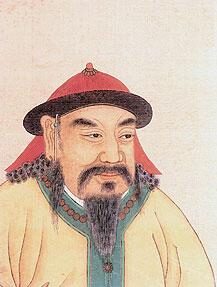
Yesugei
Yesugei was a Mongol warlord and father of Genghis Khan. Born December 28, 1134, in Khamag Mongol. Died June 11, 1171, in Khamag Mongol.
Facts
22 facts · 2 confirmed by two sources · 0 cited · 20 from one source
Where this comes from
Papalocal keeps its own record. It started from these sources; what each one said is kept here as it was copied, so a change on their side never changes this page by itself. Tap one to read its version.
What Wikidata says · copied November 16, 2026 · revision 2563812864
- Described as
- Mongol warlord and father of Genghis Khan
- Other names
- Yesukhei Yesuhei, Beierzhijin Yesugai, Liezu, Shenyuan Huangdi
- Born
- December 28, 1134
- Died
- June 11, 1171
- Born in
- Khamag Mongol
- Died in
- Khamag Mongol
- Cause of death
- poisoning
- Name at birth
- Yesugai-Baghaturnat
- Citizen of
- Khamag Mongol
- Occupation
- warrior
- Spouse
- Hoelun; Sochigel
- Children
- Genghis Khan; Qasar; Hachiun; Temüge; Behter; Belgutei; Temulin
- Father
- Bartan Baator
- Siblings
- Daridai Otchigin; Niekundasi; Mönggetu Qiyan
- Religion
- Tengrism · 1 reference
- Wikipedias with a page
- 39
Wikidata item Q573157 (wikidata.org/wiki/Q573157), public domain (CC0). Copied November 16, 2026.
What Wikipedia says · copied November 16, 2026 · revision 1373053559
Yesugei or Yesükhei Baghatur (c. 1134–1171) was a major chief of the Khamag Mongol confederation and the father of Temüjin, who later became known as Genghis Khan. Yesügei was from the Borjigin family, and his name means "like nine", meaning he had the auspicious qualities of the number nine, a lucky number to the Mongols.
- Born, in its opening lines
- 1134
- Died, in its opening lines
- 1171
From the Wikipedia article “Yesugei” (en.wikipedia.org/wiki/Yesugei), by its contributors, under CC BY-SA 4.0 (creativecommons.org/licenses/by-sa/4.0/). Copied November 16, 2026; not changed.
Confirmed Two sources agree. Cited One source, and it names where it got it. One source One source, without a reference of its own. Sources disagree The sources disagree. We show the best-supported value and keep theirs below.
