
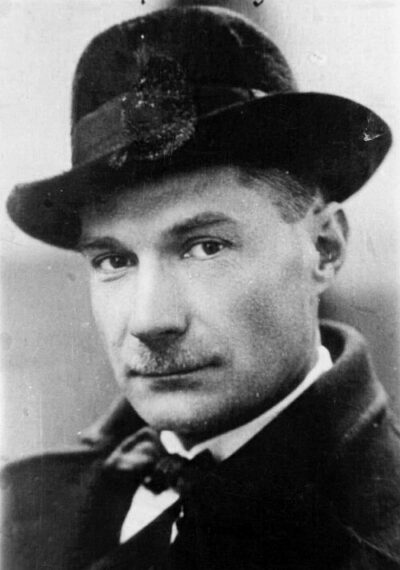
Yevgeny Zamyatin
Yevgeny Zamyatin was a Russian author. Born January 20, 1884, in Lebedyan. Died March 10, 1937, in 16th arrondissement of Paris. Known for We. Educated at Saint Petersburg Polytechnic Institute. Awards include Prometheus Award - Hall of Fame.
Facts
29 facts · 1 confirmed by two sources · 7 cited · 20 from one source · 1 where the sources disagree
What’s different
- Born: we show January 20, 1884 (Sources disagree). Wikipedia says February 1, 1884
Where this comes from
Papalocal keeps its own record. It started from these sources; what each one said is kept here as it was copied, so a change on their side never changes this page by itself. Tap one to read its version.
What Wikidata says · copied November 16, 2026 · revision 2567315616
- Described as
- Russian author (1884–1937)
- Other names
- Yevgeny Ivanovich Zamyatin, Eugene Zamyatin, Zamâtin Evgenij Ivanovič
- Born
- January 20, 1884 · 4 references
- Died
- March 10, 1937 · 11 references
- Born in
- Lebedyan · 3 references
- Died in
- 16th arrondissement of Paris
- Buried in
- Cimetière parisien de Thiais · 1 reference
- Name at birth
- Евге́ний Ива́нович Замя́тин
- Citizen of
- Russian Empire; Soviet Union
- Occupation
- science fiction writer · 1 reference; engineer; satirist; librettist; screenwriter; playwright; writer · 2 references; literary critic
- Political party
- Bolsheviks
- Worked for
- Peter the Great Saint Petersburg State Polytechnical University
- Education
- Saint Petersburg Polytechnic Institute (–1908) · 1 reference
- Genre
- science fiction; political satire; dystopian fiction; speculative fiction; theatre; libretto
- Known for
- We
- Awards
- Prometheus Award - Hall of Fame (1994)
- Field
- literary activity · 1 reference; literary criticism · 1 reference
- Wikipedias with a page
- 73
Wikidata item Q204868 (wikidata.org/wiki/Q204868), public domain (CC0). Copied November 16, 2026.
What Wikipedia says · copied November 16, 2026 · revision 1376236199
Yevgeny Ivanovich Zamyatin (Russian: Евге́ний Ива́нович Замя́тин, IPA: [jɪvˈɡʲenʲɪj ɪˈvanəvʲɪdʑ zɐˈmʲætʲɪn]; 1 February [O.S. 20 January] 1884 – 10 March 1937), sometimes anglicized as Eugene Zamiatin, was a Russian author of science fiction, philosophy, literary criticism, and political satire.
The son of a Russian Orthodox priest, Zamyatin abandoned Christianity at an early age and became a Bolshevik. As a member of his Party's Pre-Revolutionary underground, Zamyatin was repeatedly arrested, beaten, imprisoned, and exiled. But Zamyatin was just as deeply disturbed by the policies pursued by the All-Union Communist Party (Bolsheviks) following the October Revolution as he had been by Tsarist policy.
Due to his subsequent use of literature to both satirize and criticize the Soviet Union's enforced conformity and increasing totalitarianism, Zamyatin, whom Mirra Ginsburg has dubbed "a man of incorruptible and uncompromising courage," is now considered one of the first Soviet dissidents. He is most famous for his highly influential and widely imitated 1921 dystopian science fiction novel We, which is set in a futuristic police state.
In 1921, We became the first work banned by the Soviet censorship board. Ultimately, Zamyatin arranged for We to be smuggled to the West for publication. The outrage this sparked within the Party and the Union of Soviet Writers led directly to the State-organized defamation and blacklisting of Zamyatin and his successful request for permission from Joseph Stalin to leave his homeland. In 1937 he died in poverty in Paris.
After his death, Zamyatin's writings were circulated in samizdat and continued to inspire multiple generations of Soviet dissidents.
- Born, in its opening lines
- February 1, 1884
- Died, in its opening lines
- March 10, 1937
From the Wikipedia article “Yevgeny Zamyatin” (en.wikipedia.org/wiki/Yevgeny_Zamyatin), by its contributors, under CC BY-SA 4.0 (creativecommons.org/licenses/by-sa/4.0/). Copied November 16, 2026; not changed.
Confirmed Two sources agree. Cited One source, and it names where it got it. One source One source, without a reference of its own. Sources disagree The sources disagree. We show the best-supported value and keep theirs below.
