
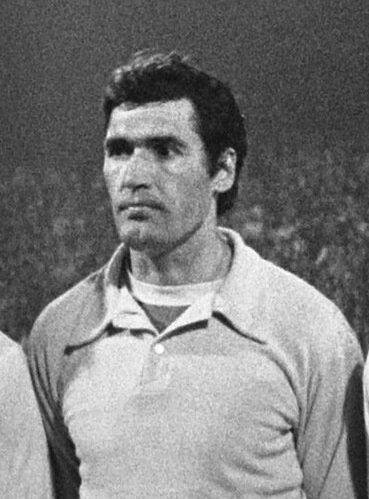
Yevhen Rudakov
Yevhen Rudakov was a Soviet footballer. Born January 2, 1942, in Moscow. Died December 21, 2011, in Kyiv. Teams include MFC Mykolaiv (1961–1962), FC Dynamo Kyiv (1962–1977) and FC Torpedo Moscow (1958–1960). Awards include Master of Sport of the USSR, International Class, Medal "For Distinguished Labour" and Order of Merit (Ukraine), 3rd class.
Facts
22 facts · 2 confirmed by two sources · 0 cited · 20 from one source
Where this comes from
Papalocal keeps its own record. It started from these sources; what each one said is kept here as it was copied, so a change on their side never changes this page by itself. Tap one to read its version.
What Wikidata says · copied November 17, 2026 · revision 2555460454
- Described as
- Soviet footballer (1942-2011)
- Other names
- Yevgeniy Vasilievich Rudakov
- Born
- January 2, 1942
- Died
- December 21, 2011 · 1 reference
- Born in
- Moscow
- Died in
- Kyiv
- Buried in
- Baikove Cemetery
- Citizen of
- Soviet Union; Ukraine
- Occupation
- association football player; association football coach
- Teams
- MFC Mykolaiv (1961–1962); FC Dynamo Kyiv (1962–1977); FC Torpedo Moscow (1958–1960); Soviet Union national association football team (1968–1976); Soviet Union national under-21 football team (1972); FC Spartak Ivano-Frankivsk (1979); MFC Kremin Kremenchuk (1994)
- Sport
- association football
- Awards
- Master of Sport of the USSR, International Class; Medal "For Distinguished Labour"; Order of Merit (Ukraine), 3rd class; Honoured Master of Sports of the USSR
- Height
- 1.90 m (6 ft 3 in) · 1 reference
- Wikipedias with a page
- 25
Wikidata item Q940172 (wikidata.org/wiki/Q940172), public domain (CC0). Copied November 17, 2026.
What Wikipedia says · copied November 17, 2026 · revision 1382508153
Yevgeniy Vasilievich Rudakov (Russian: Евгений Васильевич Рудаков; 2 January 1942 – 21 December 2011) was a Soviet footballer who played as a goalkeeper. In 1971, he was recognized as the Best Ukrainian Player of the Year becoming the first foreigner to be awarded such honors.
A six-time domestic champion of the Soviet Union with Dynamo Kyiv, Rudakov also helped Dynamo win the Soviet Cup twice, the Cup Winners' Cup and the UEFA Super Cup. He also represented the USSR national football team and helped them reach the finals of Euro 1972 finals. After the UEFA Euro 1972 along with his teammates by Soviet Union national football team – Revaz Dzodzuashvili and Murtaz Khurtsilava – he was included in the team of the tournament, along with such great players as Franz Beckenbauer, Gerd Müller, Paul Breitner, Uli Hoeness and Günter Netzer. In 1971 Rudakov was also chosen the Soviet Footballer of the Year and the best goalkeeper of the USSR in 1969, 1971, and 1972.
At the Olympic Games 1972 he earned four wins and two shutouts. He also won 21 games with the regular senior squad and finished 22 games without allowing any goals. His career goals against average was at 0.69.
After finishing his playing career, he coached few Ukraine-based clubs, but mostly stayed on at Dynamo Kyiv's sport school as a children coach.
He was nominated twice for the Ballon d'Or, in 1971 when he came 12th, and 1972 when he came 18th.
- Born, in its opening lines
- January 2, 1942
- Died, in its opening lines
- December 21, 2011
From the Wikipedia article “Yevhen Rudakov” (en.wikipedia.org/wiki/Yevhen_Rudakov), by its contributors, under CC BY-SA 4.0 (creativecommons.org/licenses/by-sa/4.0/). Copied November 17, 2026; not changed.
Confirmed Two sources agree. Cited One source, and it names where it got it. One source One source, without a reference of its own. Sources disagree The sources disagree. We show the best-supported value and keep theirs below.
