
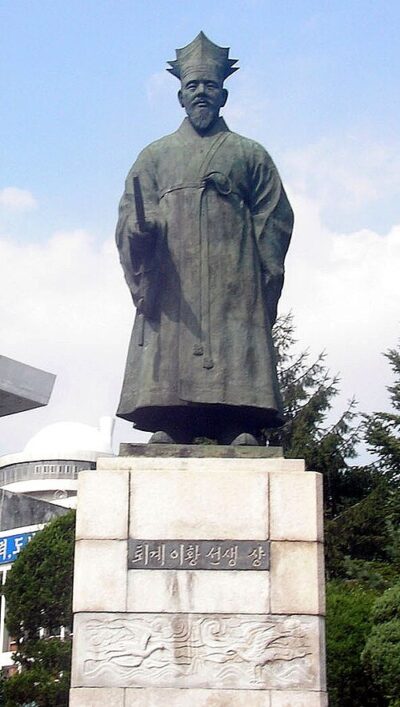
Yi Hwang
Yi Hwang was a Korean Confucian scholar. Born 1501, in Andong. Died 1570, in Andong.
Facts
11 facts · 2 confirmed by two sources · 1 cited · 8 from one source
Where this comes from
Papalocal keeps its own record. It started from these sources; what each one said is kept here as it was copied, so a change on their side never changes this page by itself. Tap one to read its version.
What Wikidata says · copied November 16, 2026 · revision 2553987093
- Described as
- Korean Confucian scholar (1502 -1571)
- Other names
- Toegye, Tchökje, Lee Hwang
- Born
- 1501 · 10 references
- Died
- 1570 · 10 references
- Born in
- Andong
- Died in
- Andong
- Cause of death
- disease
- Citizen of
- Joseon
- Occupation
- philosopher; writer; scholar · 1 reference
- Member of
- The eighteen sages of Korea · 1 reference
- Religion
- Confucianism
- Wikipedias with a page
- 30
Wikidata item Q486291 (wikidata.org/wiki/Q486291), public domain (CC0). Copied November 16, 2026.
What Wikipedia says · copied November 16, 2026 · revision 1381068044
Yi Hwang (Korean: 이황; Hanja: 李滉; 1501–1570) was a Korean philosopher, writer, and Confucian scholar of the Joseon period. He is considered the most important philosopher of Korea - he is honored by printing his portrait on the 1000 South Korean won banknote, on the reverse of which one can see an image of his school, Dosan Seowon. He was of the Neo-Confucian literati, established the Yeongnam School and set up the Dosan Seowon, a private Confucian academy.
Yi Hwang is often referred to by his art name Toegye ("Retreating Creek"). His courtesy name was Gyeongho.
His interpretation of Neo-Confucianism was influential not only in Korea, but also in Japan, Taiwan, and Vietnam, and is now being studied even in the mainland China. His main work, Ten Diagrams on Sage Learning, originally published in classical Chinese language, has been already translated into modern Korean, Japanese, Vietnamese, English, French, German, Russian and Polish.
Some of his writings were looted by the Japanese military during the Japanese invasion of Korea.
- Born, in its opening lines
- 1501
- Died, in its opening lines
- 1570
From the Wikipedia article “Yi Hwang” (en.wikipedia.org/wiki/Yi_Hwang), by its contributors, under CC BY-SA 4.0 (creativecommons.org/licenses/by-sa/4.0/). Copied November 16, 2026; not changed.
Confirmed Two sources agree. Cited One source, and it names where it got it. One source One source, without a reference of its own. Sources disagree The sources disagree. We show the best-supported value and keep theirs below.
