
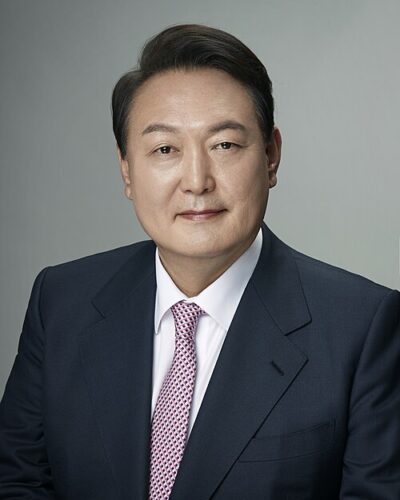
Yoon Suk Yeol
Yoon Suk Yeol is a President of South Korea from 2022 to 2025. Born December 18, 1960, in Seongbuk District. Positions held include Prosecutor General of South Korea (2019–2021) and President of South Korea (2022–2025). Educated at Chungam High School and Seoul National University. Awards include Time 100, Profile in Courage Award and Order of Merit for National Foundation.
Facts
25 facts · 1 confirmed by two sources · 7 cited · 17 from one source
Where this comes from
Papalocal keeps its own record. It started from these sources; what each one said is kept here as it was copied, so a change on their side never changes this page by itself. Tap one to read its version.
What Wikidata says · copied November 16, 2026 · revision 2569413262
- Described as
- President of South Korea from 2022 to 2025
- Other names
- Yoon Seok Yeol, Yun Sŏkyŏl, Ambrose Yoon, Yun Seokyeol, Yoon Suk-yeol
- Born
- December 18, 1960 · 1 reference
- Born in
- Seongbuk District · 1 reference
- Citizen of
- South Korea
- Occupation
- prosecutor; lawyer; politician · 1 reference; jurist · 1 reference
- Positions held
- Prosecutor General of South Korea (2019–2021); President of South Korea (2022–2025) · 1 reference
- Political party
- People Power Party (2021–2025) · 1 reference
- Education
- Chungam High School; Seoul National University; Judicial Research and Training Institute
- Awards
- Time 100 (2022) · 1 reference; Profile in Courage Award (2023) · 1 reference; Order of Merit for National Foundation · 1 reference; Order of the White Eagle · 1 reference; Grand Cross of the Legion of Honour · 1 reference; Order of Merit of the Italian Republic · 1 reference; Order of the Bath · 1 reference; Order of the Netherlands Lion · 1 reference
- Spouse
- Kim Keon Hee (2012–) · 1 reference
- Father
- Yoon Ki-jung · 1 reference
- Mother
- Choi Seong-ja
- Religion
- Catholicism · 1 reference
- Wikipedias with a page
- 91
Wikidata item Q16090635 (wikidata.org/wiki/Q16090635), public domain (CC0). Copied November 16, 2026.
What Wikipedia says · copied November 16, 2026 · revision 1385940502
Yoon Suk Yeol (Korean: 윤석열; pronounced [jun sʰʌŋnjʌɭ]; born 18 December 1960) is a South Korean politician who served as the 13th President of South Korea from 2022 until his removal from office in 2025. A member of the People Power Party during his presidency, he had the shortest presidency as an elected leader in the country's democratic history. Yoon previously served as prosecutor general from 2019 to 2021. Yoon is currently serving a life sentence in prison after being convicted of heading an insurrection and other crimes.
Born in Seoul, Yoon received his bachelor's and master's degrees in law from Seoul National University. In his capacity as chief of the Seoul Central District Prosecutor's Office, he played a key role in convicting former presidents Park Geun-hye and Lee Myung-bak for corruption and abuse of power. In 2019, President Moon Jae-in appointed Yoon as Prosecutor General of South Korea. Under Yoon's leadership, the Supreme Prosecutor's Office conducted embattled investigations into Cho Kuk, an influential figure in the Moon administration, that led to Cho's resignation as Minister of Justice. Yoon's clashes with the Moon administration prior to his resignation as prosecutor general in 2021 led to his rise as a potential presidential candidate among conservative voters.
On 29 June 2021, Yoon announced his candidacy in the 2022 presidential election. He joined the People Power Party (PPP) in July and won its nomination in November. Considered a conservative politician, Yoon ran on a platform promising economic deregulation, opposing feminism, and on measures such as abolishing the Ministry of Gender Equality and Family. He narrowly defeated Democratic Party nominee Lee Jae Myung by less than a percentage point on 9 March 2022 and assumed office as president on 10 May, becoming the first elected president to be born after the end to fighting in the Korean War. During his presidency, Yoon pursued friendlier relations with Japan and the United States, and has been described as hawkish toward North Korea. His handling of the Seoul Halloween crowd crush in 2022 and the medical crisis has attracted criticism. In the 2024 parliamentary midterm elections, Yoon's party suffered a defeat, which weakened his political power. Under Yoon's tenure, South Korea underwent democratic backsliding and a shift towards authoritarianism. He received mostly low approval ratings as president and had been described as a lame duck.
On 3 December 2024, Yoon attempted a self-coup by declaring martial law, the first time it had been declared in South Korea since the military dictatorship of Chun Doo-hwan in 1980. He accused members of the National Assembly of supporting North Korea, but lifted martial law after the Assembly passed an emergency motion nullifying the declaration a few hours later. Amid widespread criticism and mass protests, an impeachment motion was introduced against Yoon the next day, though it fell short of the 200 votes needed to pass. Yoon was successfully impeached and suspended from his presidential powers in a second vote ten days later. Yoon subsequently became the first sitting president in South Korean history to face an arrest warrant and, in January 2025, the first to be arrested and incarcerated. On 4 April, the Constitutional Court unanimously upheld Yoon's impeachment by the National Assembly, officially terminating his presidency. Yoon announced his departure from the PPP in May. In February 2026, he was sentenced to life imprisonment without parole over the martial law declaration. Yoon is serving his sentence at Seoul Detention Center and faces ongoing multiple criminal trials in relation to other charges from the martial law declaration and other scandals.
- Born, in its opening lines
- December 18, 1960
From the Wikipedia article “Yoon Suk Yeol” (en.wikipedia.org/wiki/Yoon_Suk_Yeol), by its contributors, under CC BY-SA 4.0 (creativecommons.org/licenses/by-sa/4.0/). Copied November 16, 2026; not changed.
Confirmed Two sources agree. Cited One source, and it names where it got it. One source One source, without a reference of its own. Sources disagree The sources disagree. We show the best-supported value and keep theirs below.
