
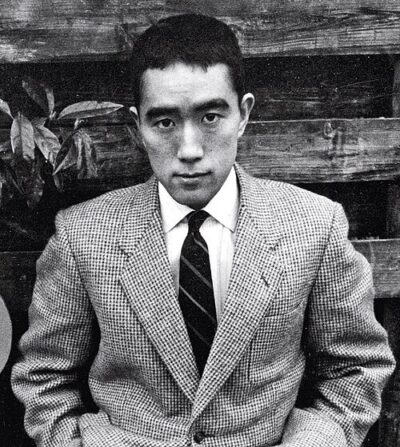
Yukio Mishima
Yukio Mishima was a Japanese author. Born January 14, 1925, in Tokyo. Died November 25, 1970, in Tokyo. Known for The Temple of the Golden Pavilion, Confessions of a Mask and The Sea of Fertility. Educated at University of Tokyo, Faculty of Law, Graduate Schools for Law and Politics. Awards include Shinchosha literature award, Kishida Theatre Award and Yomiuri Prize.
Facts
61 facts · 2 confirmed by two sources · 14 cited · 45 from one source
Where this comes from
Papalocal keeps its own record. It started from these sources; what each one said is kept here as it was copied, so a change on their side never changes this page by itself. Tap one to read its version.
What Wikidata says · copied November 16, 2026 · revision 2567305651
- Described as
- Japanese author (1925–1970)
- Other names
- Mishima Yukio, Kimitake Hiraoka, Hiraoka Kimitake
- Born
- January 14, 1925 · 10 references
- Died
- November 25, 1970 · 11 references
- Born in
- Tokyo
- Died in
- Tokyo
- Buried in
- Tama Cemetery
- Cause of death
- seppuku
- Name at birth
- 平岡 公威
- Citizen of
- Japan
- Occupation
- writer · 1 reference; prose writer; novelist; playwright · 1 reference; screenwriter; poet · 1 reference; essayist; translator
- Worked for
- Ministry of the Treasury; Bungakuza
- Education
- University of Tokyo, Faculty of Law, Graduate Schools for Law and Politics
- Member of
- Tatenokai
- Sport
- bodybuilding; kendo; karate
- Genre
- drama; manifesto; lecture; short film; essay
- Record label
- King Records
- Known for
- The Temple of the Golden Pavilion; Confessions of a Mask; The Sea of Fertility; The Sound of Waves; The Sailor Who Fell from Grace with the Sea; Kyōko no Ie; Patriotism; Five Modern No Plays; Madame de Sade
- Awards
- Shinchosha literature award (1954); Kishida Theatre Award (1955); Yomiuri Prize (1956); Mainichi art award (1964); ACA National Arts Festival (1965); Golden Arrow Award; star on Playwrights' Sidewalk · 1 reference
- Field
- creative and professional writing · 1 reference; theatre; acting · 1 reference; modelling · 1 reference; political activity · 1 reference; poetry · 1 reference
- Spouse
- Yōko Hiraoka (1958–1970) · 1 reference
- Children
- Noriko Hiraoka; Iichirō Hiraoka
- Father
- Azusa Hiraoka · 1 reference
- Mother
- Shizue Hiraoka · 1 reference
- Siblings
- Chiyuki Hiraoka · 1 reference; Mitsuko Hiraoka · 1 reference
- Religion
- Shinto; Yamato-damashii · 1 reference
- Height
- 1.63 m (5 ft 4 in)
- Wikipedias with a page
- 111
Wikidata item Q134456 (wikidata.org/wiki/Q134456), public domain (CC0). Copied November 16, 2026.
What Wikipedia says · copied November 16, 2026 · revision 1385066745
Kimitake Hiraoka (平岡 公威, Hiraoka Kimitake; 14 January 1925 – 25 November 1970), known by his pen name Yukio Mishima (三島 由紀夫, Mishima Yukio), was a Japanese writer. He is considered one of the most important postwar stylists of the Japanese language.
Mishima was nominated for the Nobel Prize in Literature five times in the 1960s—including in 1968 when the award went to his countryman and benefactor Yasunari Kawabata. Mishima's works include the novels Confessions of a Mask and The Temple of the Golden Pavilion, and the autobiographical essay Sun and Steel. Mishima's work is characterized by "its luxurious vocabulary and decadent metaphors, its fusion of traditional Japanese and modern Western literary styles, and its obsessive assertions of the unity of beauty, eroticism, and death," according to the author Andrew Rankin.
Mishima's political activities made him a controversial figure; he remains so in Japan to the present day. From his mid-30s onwards, Mishima's far-right ideology and reactionary beliefs became increasingly evident. He extolled the traditional culture and spirit of Japan, and opposed what he saw as Western-style materialism, along with Japan's postwar democracy, globalism, and communism, worrying that by embracing these ideas the Japanese people would lose their "national essence" (kokutai) and distinctive cultural heritage to become a "rootless" people.
In 1968, Mishima formed the Tatenokai ("Shield Society"), a private militia, for the purpose of protecting the dignity of the emperor as a symbol of national identity. The Tatenokai are interpreted by scholars as attempting to reclaim Japan's prewar values of loyalty. Yukio Mishima believed the traditions that made Japan great had been weakened by postwar Japan. Although the Tatenokai were legally allowed in postwar Japan, their ideology directly opposed the newfound pacifism that was adopted. On 25 November 1970, Mishima and four members of his militia entered a military base in central Tokyo, took its commandant hostage, and unsuccessfully tried to inspire the Japan Self-Defense Forces to rise up and overthrow Article 9 of the 1947 Constitution to restore autonomous national defense and the divinity of the emperor. The incident ended with Mishima's suicide by seppuku, which had been planned.
- Born, in its opening lines
- January 14, 1925
- Died, in its opening lines
- November 25, 1970
From the Wikipedia article “Yukio Mishima” (en.wikipedia.org/wiki/Yukio_Mishima), by its contributors, under CC BY-SA 4.0 (creativecommons.org/licenses/by-sa/4.0/). Copied November 16, 2026; not changed.
Confirmed Two sources agree. Cited One source, and it names where it got it. One source One source, without a reference of its own. Sources disagree The sources disagree. We show the best-supported value and keep theirs below.
