
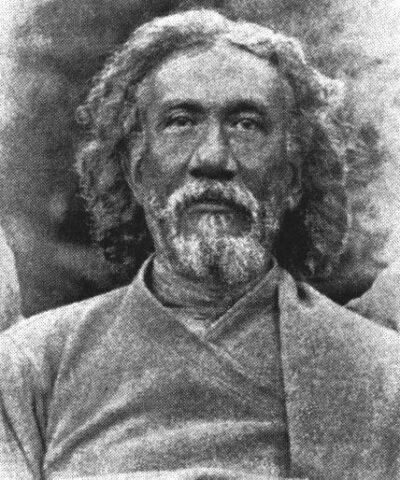
Yukteswar Giri
Yukteswar Giri was an Indian yogi, occultist and guru. Born May 10, 1855, in Serampore. Died March 9, 1936, in Puri. Educated at University of Calcutta.
Facts
9 facts · 2 confirmed by two sources · 1 cited · 6 from one source
Where this comes from
Papalocal keeps its own record. It started from these sources; what each one said is kept here as it was copied, so a change on their side never changes this page by itself. Tap one to read its version.
What Wikidata says · copied November 16, 2026 · revision 2567283887
- Described as
- Indian yogi, occultist and guru (1855-1936)
- Other names
- Sri Yukteswar Giri, Sri Yukteshwar
- Born
- May 10, 1855 · 1 reference
- Died
- March 9, 1936 · 1 reference
- Born in
- Serampore · 1 reference
- Died in
- Puri
- Citizen of
- British Raj
- Occupation
- astrologer
- Education
- University of Calcutta
- Field
- philosophy
- Religion
- Hinduism
- Wikipedias with a page
- 49
Wikidata item Q380790 (wikidata.org/wiki/Q380790), public domain (CC0). Copied November 16, 2026.
What Wikipedia says · copied November 16, 2026 · revision 1364010937
Swami Sri Yukteswar Giri (also written Sriyuktesvara, Sri Yukteshwar) (10 May 1855 – 9 March 1936) is the monastic name of Priya Nath Karar (also spelled as Priya Nath Karada and Preonath Karar), an Indian monk and yogi, and the guru of Paramahansa Yogananda and Swami Satyananda Giri. Born in Serampore, West Bengal, Sri Yukteswar was a Kriya yogi, a Jyotishi (Vedic astrologer), a scholar of the Bhagavad Gita and the Upanishads, an educator, author, and astronomer. He was a disciple of Lahiri Mahasaya of Varanasi and a member of the Giri branch of the Swami order. As a guru, he had two ashrams, one in Serampore and another in Puri, Odisha, between which he alternated his residence throughout the year as he trained disciples.
Described by Tibetologist W.Y. Evans-Wentz as being "of gentle mien and voice, of pleasing presence," and with "high character and holiness," Sri Yukteswar was a progressive-minded figure in 19th-century Serampore society; he regularly held religious festivals throughout the year around the towns and at his ashrams, created a "Satsanga Sabha" spiritual study organisation, established syllabi for educational institutions, and re-analysed the Vedic astrological yugas. Noted for his sharp mind and insightful knowledge, he became a respected guru throughout the greater Kolkata area to his Kriya yoga students, and also regularly invited individuals from all social backgrounds to his ashrams to discuss and exchange ideas on a range of topics.
As a guru, he was nonetheless known for his candid insight, stern nature and strict disciplinary training methods, as noted by his disciple Yogananda in his autobiography. The rigorous nature of his training eventually prepared his disciples, such as Satyananda and Yogananda himself, for their own intense social work in India and America, respectively. In accordance with the high ideals and "penetrating insight" with which he lived, Sri Yukteswar was considered by Yogananda as a Jnanavatar, or "Incarnation of Wisdom;" Evans-Wentz felt him "worthy of the veneration which his followers spontaneously accorded to him...Content to remain afar from the multitude, he gave himself unreservedly and in tranquility to that ideal life which Paramhansa Yogananda, his disciple, has now described for the ages."
- Born, in its opening lines
- May 10, 1855
- Died, in its opening lines
- March 9, 1936
From the Wikipedia article “Swami Sri Yukteswar Giri” (en.wikipedia.org/wiki/Swami_Sri_Yukteswar_Giri), by its contributors, under CC BY-SA 4.0 (creativecommons.org/licenses/by-sa/4.0/). Copied November 16, 2026; not changed.
Confirmed Two sources agree. Cited One source, and it names where it got it. One source One source, without a reference of its own. Sources disagree The sources disagree. We show the best-supported value and keep theirs below.
