
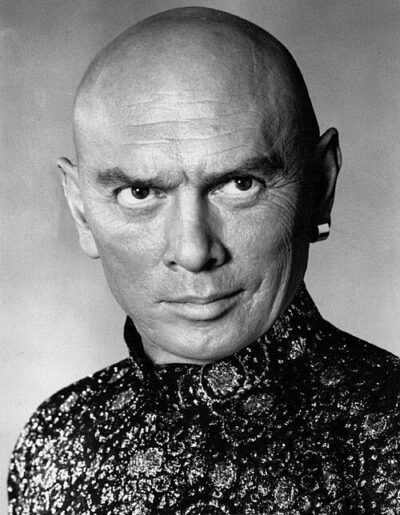
Yul Brynner
Yul Brynner was a Russian-born American actor. Born July 11, 1920, in Vladivostok. Died October 10, 1985, in New York City. Educated at World Alliance of YMCAs. Awards include Tony Award for Best Featured Actor in a Musical, Academy Award for Best Actor and National Board of Review Award for Best Actor.
Facts
31 facts · 2 confirmed by two sources · 9 cited · 19 from one source · 1 where the sources disagree
What’s different
- Name at birth: we show Юлий Борисович Бринер (Sources disagree). Wikidata also lists Julij Boriszovics Brinyer
Where this comes from
Papalocal keeps its own record. It started from these sources; what each one said is kept here as it was copied, so a change on their side never changes this page by itself. Tap one to read its version.
What Wikipedia says · copied November 13, 2026 · revision 1383910294
Yuliy Borisovich Briner (Russian: Юлий Борисович Бринер; July 11, 1920 – October 10, 1985), known professionally as Yul Brynner (Russian: Юл Бриннер), was a Russian and American actor. He was known for his portrayal of King Mongkut in the Rodgers and Hammerstein stage musical The King and I (1951), for which he won two Tony Awards, and later an Academy Award for Best Actor for the 1956 film adaptation. He played the role 4,625 times on stage, and became known for his shaved head, which he maintained as a personal trademark long after adopting it for The King and I.
Considered one of the first Russian-American film stars, he was honored with a ceremony to put his handprints in front of Grauman's Chinese Theatre in Hollywood in 1956. He also received a star on the Hollywood Walk of Fame in 1960.
In 1956, Brynner received the National Board of Review Award for Best Actor for his portrayals of Rameses II in the Cecil B. DeMille epic The Ten Commandments and General Bounine in Anastasia. He was also well known as the gunman Chris Adams in The Magnificent Seven (1960) and its first sequel, Return of the Seven (1966). He had roles as the android "The Gunslinger" in Westworld (1973) and its sequel Futureworld (1976).
In addition to his film credits, he worked as a model and photographer, and wrote several books.
- Born, in its opening lines
- July 11, 1920
- Died, in its opening lines
- October 10, 1985
From the Wikipedia article “Yul Brynner” (en.wikipedia.org/wiki/Yul_Brynner), by its contributors, under CC BY-SA 4.0 (creativecommons.org/licenses/by-sa/4.0/). Copied November 13, 2026; not changed.
What Wikidata says · copied November 14, 2026 · revision 2569151868
- Described as
- Russian-born American actor (1920–1985)
- Other names
- Taidje Khan, Youl Bryner, Yuliy Borisovich Bryner, Yuliy Borisovich Briner
- Born
- July 11, 1920 · 6 references
- Died
- October 10, 1985 · 11 references
- Born in
- Vladivostok · 3 references
- Died in
- New York City · 4 references
- Buried in
- Royal abbey of Saint-Michel de Bois-Aubry · 1 reference
- Cause of death
- lung cancer
- Name at birth
- Юлий Борисович Бринер; Julij Boriszovics Brinyer
- Citizen of
- Far Eastern Republic; United States (1943–1965); Switzerland · 1 reference
- Occupation
- film actor; television director · 3 references; photographer · 3 references; writer · 3 references; musician · 2 references; stage actor; actor · 1 reference; television actor · 1 reference
- Education
- World Alliance of YMCAs
- Sport
- acrobatics
- Awards
- Tony Award for Best Featured Actor in a Musical (1952); Academy Award for Best Actor (1957) · 1 reference; National Board of Review Award for Best Actor (1956); Special Tony Award (1985); Grammy Hall of Fame (1999); star on Hollywood Walk of Fame · 1 reference; Tony Awards (1952) · 1 reference
- Spouse
- Virginia Gilmore (1944–1960)
- Children
- Victoria Brynner
- Religion
- Eastern Orthodox Church
- Height
- 1.73 m (5 ft 8 in)
- Wikipedias with a page
- 73
Wikidata item Q102813 (wikidata.org/wiki/Q102813), public domain (CC0). Copied November 14, 2026.
Confirmed Two sources agree. Cited One source, and it names where it got it. One source One source, without a reference of its own. Sources disagree The sources disagree. We show the best-supported value and keep theirs below.
