
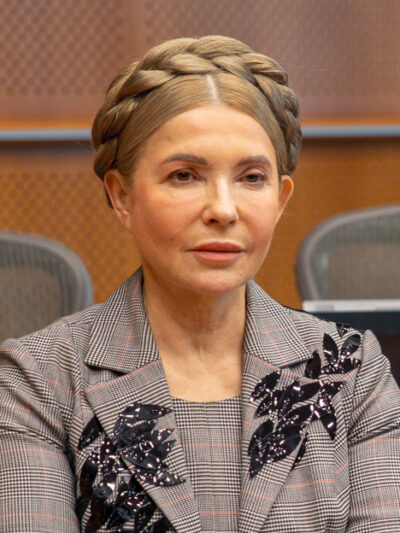
Yulia Tymoshenko
Yulia Tymoshenko is an Ukrainian politician, former Prime Minister. Born November 27, 1960, in Dnipro. Positions held include Deputy Prime Minister of Ukraine (1999–2001), People's Deputy of Ukraine (3 times) (1997–) and Prime Minister of Ukraine (2 times) (2005–2010). Educated at Dnipro University of Technology and Oles Honchar Dnipro National University. Awards include Miner's Glory 2nd class, Miner's Glory 3rd class and Order of the Great September Revolution 1969.
Facts
30 facts · 1 confirmed by two sources · 3 cited · 26 from one source
Where this comes from
Papalocal keeps its own record. It started from these sources; what each one said is kept here as it was copied, so a change on their side never changes this page by itself. Tap one to read its version.
What Wikidata says · copied November 16, 2026 · revision 2565409835
- Described as
- Ukrainian politician, former Prime Minister
- Other names
- Yulia Volodymyrivna Tymoshenko, Julia Tymoshenko, Yuliya Tymoshenko, Юлія Тимошенко
- Born
- November 27, 1960 · 3 references
- Born in
- Dnipro
- Name at birth
- Юлія Володимирівна Грігян
- Citizen of
- Soviet Union (–1991); Ukraine
- Occupation
- economist; politician · 1 reference; entrepreneur
- Positions held
- Deputy Prime Minister of Ukraine (1999–2001); People's Deputy of Ukraine (3 times) (1997–) · 1 reference; Prime Minister of Ukraine (2 times) (2005–2010)
- Political party
- Batkivshchyna (1999–)
- Education
- Dnipro University of Technology; Oles Honchar Dnipro National University
- Member of
- 8th Verkhovna Rada; 9th Verkhovna Rada; 6th Verkhovna Rada; 5th Verkhovna Rada; 4th Verkhovna Rada; 3rd Verkhovna Rada
- Awards
- Miner's Glory 2nd class · 1 reference; Miner's Glory 3rd class · 1 reference; Order of the Great September Revolution 1969 (2009); Order of the holy Great Martyr Barbara 2nd class (1998); Order of the Orthodox Crusaders of the Holy Sepulchre (2009)
- Spouse
- Oleksandr Tymošenko (1979–)
- Children
- Yevheniya Tymoshenko · 1 reference
- Father
- Volodymyr Hrihyan
- Mother
- Lyudmila Telehina
- Religion
- Eastern Orthodoxy · 1 reference
- Wikipedias with a page
- 113
Wikidata item Q48283 (wikidata.org/wiki/Q48283), public domain (CC0). Copied November 16, 2026.
What Wikipedia says · copied November 16, 2026 · revision 1384563002
Yulia Volodymyrivna Tymoshenko (née Hrihyan; born 27 November 1960) is a Ukrainian politician, who served as Prime Minister of Ukraine in 2005, and again from 2007 until 2010; the first woman in Ukraine to hold that position. She has been a member of the Verkhovna Rada as People's Deputy of Ukraine several times between 1997 and 2007, and presently as of 2014, and was First Deputy Prime Minister of Ukraine for the fuel and energy complex from 1999 to 2001. She holds a PhD degree in Economic Sciences, which is known in Ukraine and other countries as a "Candidate of Sciences" degree.
Tymoshenko is the leader of the Batkivshchyna (Ukrainian: Батьківщина) political party. She supports Ukraine's integration into the European Union and strongly opposes the membership of Ukraine in the Russia-led Eurasian Customs Union. She supports NATO membership for Ukraine.
She co-led the Orange Revolution and was the first woman twice appointed and endorsed by parliamentary majority to become prime minister, serving from 24 January to 8 September 2005, and again from 18 December 2007 to 4 March 2010. She placed third in Forbes magazine's list of the world's most powerful women in 2005.
Tymoshenko finished second in the 2010 Ukrainian presidential election runoff, losing by 3.5 percentage points to the winner, Viktor Yanukovych. From 2011 to 2014, she was detained due to a criminal case that was seen by many as politically motivated persecution by President Yanukovych, but after the Revolution of Dignity she was rehabilitated by the Supreme Court of Ukraine and the European Court of Human Rights. In the concluding days of the Revolution of Dignity, she was released after three years in jail. She again finished second in the 2014 Ukrainian presidential election, this time to Petro Poroshenko. After being a heavy favorite in the polls for several years, she came third in the first round of the 2019 Ukrainian presidential election, receiving 13.40% of the vote, thus failing to qualify for the second round.
Re-elected to Ukraine's parliament in 2019, she led her party in opposition.
- Born, in its opening lines
- November 27, 1960
From the Wikipedia article “Yulia Tymoshenko” (en.wikipedia.org/wiki/Yulia_Tymoshenko), by its contributors, under CC BY-SA 4.0 (creativecommons.org/licenses/by-sa/4.0/). Copied November 16, 2026; not changed.
Confirmed Two sources agree. Cited One source, and it names where it got it. One source One source, without a reference of its own. Sources disagree The sources disagree. We show the best-supported value and keep theirs below.
