
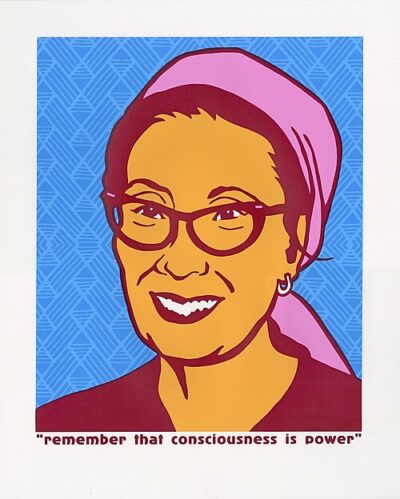
Yuri Kochiyama
Yuri Kochiyama was an American civil rights activist. Born May 19, 1921, in San Pedro. Died June 1, 2014, in Berkeley. Known for Passing it on : a memoir. Educated at Compton College and San Pedro High School.
Facts
20 facts · 2 confirmed by two sources · 4 cited · 14 from one source
Where this comes from
Papalocal keeps its own record. It started from these sources; what each one said is kept here as it was copied, so a change on their side never changes this page by itself. Tap one to read its version.
What Wikidata says · copied November 18, 2026 · revision 2541737282
- Described as
- American civil rights activist (1921-2014)
- Other names
- Mary Yuriko Nakahara, Yuri Nakahara Kochiyama
- Born
- May 19, 1921 · 1 reference
- Died
- June 1, 2014 · 1 reference
- Born in
- San Pedro
- Died in
- Berkeley · 1 reference
- Buried in
- Green Hills Memorial Park · 1 reference
- Name at birth
- Mary Yuriko Nakahara · 1 reference
- Citizen of
- United States
- Occupation
- human rights defender; militant; activist
- Education
- Compton College (1939–1941); San Pedro High School (–1939) · 1 reference
- Member of
- Asian Americans for Action (1969–); Revolutionary Action Movement (1964–); Republic of New Afrika (1969–)
- Known for
- Passing it on : a memoir
- Field
- civil and political rights; activism
- Spouse
- William Kochiyama (1946–1993) · 1 reference
- Religion
- Sunni Islam (1971–1975)
- Wikipedias with a page
- 14
Wikidata item Q8061525 (wikidata.org/wiki/Q8061525), public domain (CC0). Copied November 18, 2026.
What Wikipedia says · copied November 18, 2026 · revision 1381318309
Yuri Kochiyama (河内山 百合子 (ユリ・コウチヤマ), Kōchiyama Yuriko; born Mary Yuriko Nakahara; May 19, 1921 – June 1, 2014) was an American civil rights activist born in San Pedro, California to Japanese immigrants. She was interned at the Jerome War Relocation Center in Arkansas during World War II, an experience that influenced her views on racism in the United States. While interned, she helped run a letter-writing campaign to Nisei (transl. 'second-generation') soldiers, wrote for the Jerome camp newspaper, and volunteered with the United Service Organizations (USO). After the end of the war, Kochiyama moved to New York and eventually to Harlem, where she became involved in the civil rights movement.
At first working with the Congress of Racial Equality (CORE), Kochiyama's friendship with civil rights leader Malcolm X led her to affiliate with Black nationalist organizations such as the Organization of Afro-American Unity (OAAU), the Revolutionary Action Movement (RAM), and the Republic of New Afrika (RNA). Kochiyama advocated for political prisoners, including imprisoned members of the civil rights movement, and helped to found the National Committee to Defend Political Prisoners (NCDPP) in the early 1970s. She also supported the Puerto Rican independence movement. Kochiyama played an influential role in the Asian American movement and was a member of the organization Asian Americans for Action (AAA). In the 1980s, she participated in the redress movement for Japanese Americans interned during World War II, resulting in the signing of the Civil Liberties Act of 1988, which offered reparations to internment survivors.
Kochiyama is noted for her revolutionary nationalist views and her opposition to imperialism. She drew controversy in 2003 by praising Osama bin Laden, comparing him to Malcolm, Che Guevara, Patrice Lumumba, and Fidel Castro. She has also been the subject of several biographies, children's books, and documentaries and was nominated for a Nobel Peace Prize in 2005 alongside 1,000 other women.
- Born, in its opening lines
- May 19, 1921
- Died, in its opening lines
- June 1, 2014
From the Wikipedia article “Yuri Kochiyama” (en.wikipedia.org/wiki/Yuri_Kochiyama), by its contributors, under CC BY-SA 4.0 (creativecommons.org/licenses/by-sa/4.0/). Copied November 18, 2026; not changed.
Confirmed Two sources agree. Cited One source, and it names where it got it. One source One source, without a reference of its own. Sources disagree The sources disagree. We show the best-supported value and keep theirs below.
