
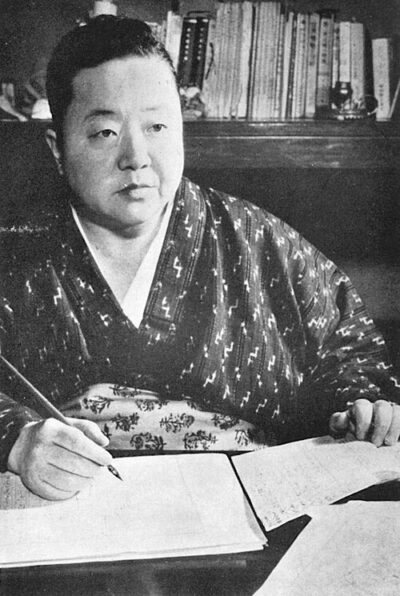
Yuriko Miyamoto
Yuriko Miyamoto was a Japanese novelist, critic, member of the Japanese Communist Party. Born February 13, 1899, in Koishikawa-ku. Died January 21, 1951, in Tokyo. Known for Nobuko and Banshū Heiya. Educated at Japan Women's University.
Facts
25 facts · 2 confirmed by two sources · 2 cited · 21 from one source
Where this comes from
Papalocal keeps its own record. It started from these sources; what each one said is kept here as it was copied, so a change on their side never changes this page by itself. Tap one to read its version.
What Wikidata says · copied November 18, 2026 · revision 2554013810
- Described as
- Japanese novelist, critic, member of the Japanese Communist Party
- Other names
- Chūjō Yuriko, Miyamoto Yuri
- Born
- February 13, 1899 · 2 references
- Died
- January 21, 1951 · 3 references
- Born in
- Koishikawa-ku
- Died in
- Tokyo · 1 reference
- Buried in
- Kodaira Cemetery
- Cause of death
- sepsis
- Name at birth
- 中條ユリ
- Citizen of
- Japan; Empire of Japan (–1947)
- Occupation
- novelist; writer; critic; literary critic; essayist; prose writer · 1 reference
- Political party
- Japanese Communist Party
- Education
- Japan Women's University
- Member of
- Nihon Puroretaria Sakka Dōmei; New Japanese Literature Association
- Known for
- Nobuko; Banshū Heiya
- Field
- essay
- Spouse
- Shigeru Araki; Kenji Miyamoto
- Father
- Chūjō Seiichirō
- Wikipedias with a page
- 21
Wikidata item Q464756 (wikidata.org/wiki/Q464756), public domain (CC0). Copied November 18, 2026.
What Wikipedia says · copied November 18, 2026 · revision 1371374050
Miyamoto Yuriko (宮本 百合子; née Chūjō (中條); 13 February 1899 – 21 January 1951) was a Japanese novelist, short-story writer, social activist, and literary critic active during the Taishō and early Shōwa eras of Japan. She is best known for her autobiographical fiction and involvement in proletarian and women's liberation movements.
Miyamoto began writing while she was still in school. She traveled for several years to the United States and the Soviet Union before returning to Japan, where her works were heavily censored and she was imprisoned repeatedly for her political views. She founded and operated a number of proletarian and feminist magazines during her career, many of which were also censored.
Her works include Nobuko, Banshū heiya (The Banshū Plain), Fūchisō (The Weathervane Plant), and other works of fiction and literary criticism. Much of her work is autobiographical and centers around themes of war, class, and gender relations. She and her husband, Miyamoto Kenji, continue to be honored by the Japanese Left for their vision and commitment toward Japanese women and the working class.
- Born, in its opening lines
- February 13, 1899
- Died, in its opening lines
- January 21, 1951
From the Wikipedia article “Miyamoto Yuriko” (en.wikipedia.org/wiki/Miyamoto_Yuriko), by its contributors, under CC BY-SA 4.0 (creativecommons.org/licenses/by-sa/4.0/). Copied November 18, 2026; not changed.
Confirmed Two sources agree. Cited One source, and it names where it got it. One source One source, without a reference of its own. Sources disagree The sources disagree. We show the best-supported value and keep theirs below.
