
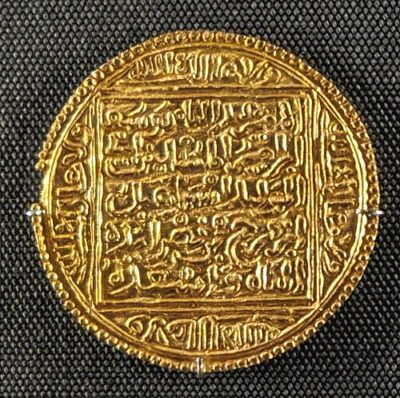
Yusuf I, Sultan of Granada
Yusuf I, Sultan of Granada was a ruler of Emirate of Granada from 1333 to 1354. Born June 29, 1318, in Granada. Died October 19, 1354, in Granada. Positions held include sultan of Granada (1333–1354).
Facts
12 facts · 2 confirmed by two sources · 3 cited · 7 from one source
Where this comes from
Papalocal keeps its own record. It started from these sources; what each one said is kept here as it was copied, so a change on their side never changes this page by itself. Tap one to read its version.
What Wikidata says · copied November 18, 2026 · revision 2553830591
- Described as
- ruler of Emirate of Granada from 1333 to 1354
- Other names
- Abu al-Hajjaj Yusuf ibn Ismail, Yusuf I, 7.Emir of Granada 1333-1354
- Born
- June 29, 1318
- Died
- October 19, 1354
- Born in
- Granada
- Died in
- Granada
- Buried in
- Málaga
- Citizen of
- Emirate of Granada
- Occupation
- king · 1 reference
- Positions held
- sultan of Granada (1333–1354)
- Children
- Ismail II; Muhammad V · 1 reference
- Father
- Ismail I, Sultan of Granada · 1 reference
- Religion
- Islam
- Wikipedias with a page
- 24
Wikidata item Q2141886 (wikidata.org/wiki/Q2141886), public domain (CC0). Copied November 18, 2026.
What Wikipedia says · copied November 18, 2026 · revision 1384840078
Abu al-Hajjaj Yusuf ibn Ismail (29 June 1318 – 19 October 1354), known by the regnal name al-Muayyad billah (lit. 'He who is aided by God'), was the seventh Nasrid ruler of the Emirate of Granada on the Iberian Peninsula. The third son of Ismail I (r. 1314–1322), he was Sultan between 1333 and 1354, after his brother Muhammad IV (r. 1325–1333) was assassinated.
Coming to the throne at age fifteen, he was initially treated as a minor and given only limited power by his ministers and his grandmother Fatima. In February 1334, his representatives secured a four-year peace treaty with Granada's neighbours Castile and the Marinid Sultanate. Aragon joined in the treaty in May. After gaining more control of the government, in 1338 or 1340 he expelled the Banu Abi al-Ula family, who had masterminded the murder of his brother and had been the leaders of the Volunteers of the Faith—North African soldiers who fought for Granada. After the treaty expired, he allied himself with Abu al-Hasan Ali (r. 1331–1348) of the Marinids against Alfonso XI of Castile (r. 1312–1350). After winning a major naval victory in April 1340, the Marinid–Granadan alliance was decisively defeated on 30 October in the disastrous Battle of Río Salado. In its aftermath, Yusuf was unable to prevent Castile from taking several Granadan castles and towns, including Alcalá de Benzaide, Locubín, Priego and Benamejí. In 1342–1344, Alfonso XI besieged the strategic port of Algeciras. Yusuf led his troops in diversionary raids into Castilian territory, and later engaged the besieging army, but the city fell in March 1344. A ten-year peace treaty with Castile followed.
In 1349, Alfonso XI broke the treaty and invaded again, laying siege to Gibraltar. Yusuf was responsible for supplying the besieged port, and led counter-attacks into Castile. The siege was lifted when Alfonso XI died of the Black Death in March 1350. Out of respect, Yusuf ordered his commanders to not attack the Castilian army as they retreated from Granadan territories carrying their king's body. Yusuf signed a treaty with Alfonso's son and successor Peter I (r. 1350–1366), even sending his troops to suppress a domestic rebellion against the Castilian king, as required by the treaty. His relation with the Marinids deteriorated when he provided refuge for the rebellious brothers of Sultan Abu Inan Faris (r. 1348–1358). He was assassinated by a madman while praying in the Great Mosque of Granada, on the day of Eid al-Fitr, 19 October 1354.
In contrast to the military and territorial losses suffered during his reign, the emirate flourished in the fields of literature, architecture, medicine and the law. Among other new buildings, he constructed the Madrasa Yusufiyya inside the city of Granada, as well as the Tower of Justice and various additions to the Comares Palace of the Alhambra. Major cultural figures served in his court, including the hajib Abu Nu'aym Ridwan, as well as the poet Ibn al-Jayyab and the polymath Ibn al-Khatib, who consecutively served as his viziers. Modern historians consider his reign, and that of his son Muhammad V (r. 1354–1359, 1362–1391), as the golden era of the Emirate.
- Born, in its opening lines
- June 29, 1318
- Died, in its opening lines
- October 19, 1354
From the Wikipedia article “Yusuf I of Granada” (en.wikipedia.org/wiki/Yusuf_I_of_Granada), by its contributors, under CC BY-SA 4.0 (creativecommons.org/licenses/by-sa/4.0/). Copied November 18, 2026; not changed.
Confirmed Two sources agree. Cited One source, and it names where it got it. One source One source, without a reference of its own. Sources disagree The sources disagree. We show the best-supported value and keep theirs below.
