
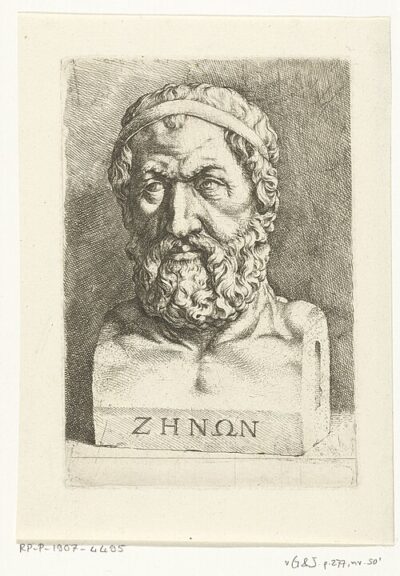
Zeno of Elea
Zeno of Elea was a Greek philosopher (c. 495 – c. 430 BC). Born 490 BC, in Velia. Died 425 BC, in Velia. Known for Zeno's paradoxes.
Facts
9 facts · 0 confirmed by two sources · 6 cited · 3 from one source
Where this comes from
Papalocal keeps its own record. It started from these sources; what each one said is kept here as it was copied, so a change on their side never changes this page by itself. Tap one to read its version.
What Wikidata says · copied November 16, 2026 · revision 2570034719
- Described as
- Greek philosopher (c. 495 – c. 430 BC)
- Other names
- Zeno
- Born
- 490 BC · 2 references
- Died
- 425 BC · 1 reference
- Born in
- Velia · 1 reference
- Died in
- Velia · 1 reference
- Occupation
- philosopher · 1 reference; mathematician · 1 reference; writer · 1 reference
- Known for
- Zeno's paradoxes
- Field
- philosophy
- Wikipedias with a page
- 98
Wikidata item Q132157 (wikidata.org/wiki/Q132157), public domain (CC0). Copied November 16, 2026.
What Wikipedia says · copied November 16, 2026 · revision 1382889044
Zeno of Elea (; Ancient Greek: Ζήνων ὁ Ἐλεάτης; c. 490 – c. 430 BC) was a pre-Socratic Greek philosopher from Elea, in what is now Southern Italy (Magna Graecia). He was a student of Parmenides and one of the Eleatics. Zeno defended his instructor's belief in monism, the idea that only one single entity exists that makes up all of reality. He rejected the existence of space, time, and motion. To disprove these concepts, he developed a series of paradoxes to demonstrate why they are impossible. Though his original writings are lost, subsequent descriptions by Plato, Aristotle, Diogenes Laertius, and Simplicius of Cilicia have allowed study of his ideas.
Zeno's arguments are divided into two different types: his arguments against plurality, or the existence of multiple objects, and his arguments against motion. Those against plurality suggest that for anything to exist, it must be divisible infinitely, meaning it would necessarily have both infinite mass and no mass simultaneously. Those against motion invoke the idea that distance must be divisible infinitely, meaning infinite steps would be required to cross any distance.
Zeno's philosophy is still debated in the present day, and no solution to his paradoxes has been agreed upon by philosophers. His paradoxes have influenced philosophy and mathematics, both in ancient and modern times. Many of his ideas have been challenged by modern developments in physics and mathematics, such as atomic theory, mathematical limits, and set theory.
From the Wikipedia article “Zeno of Elea” (en.wikipedia.org/wiki/Zeno_of_Elea), by its contributors, under CC BY-SA 4.0 (creativecommons.org/licenses/by-sa/4.0/). Copied November 16, 2026; not changed.
Confirmed Two sources agree. Cited One source, and it names where it got it. One source One source, without a reference of its own. Sources disagree The sources disagree. We show the best-supported value and keep theirs below.
