
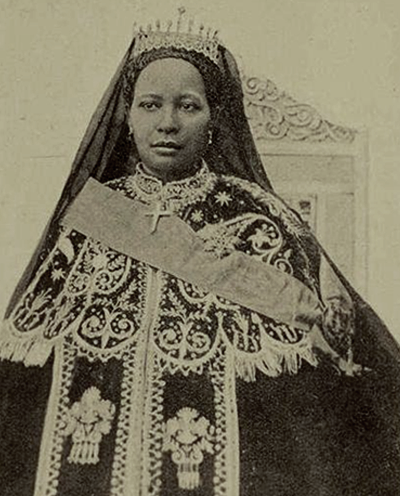
Zewditu I of Ethiopia
Zewditu I of Ethiopia was an Empress of Ethiopia. Born April 29, 1876, in Ejersa Goro. Died April 2, 1930, in Addis Ababa. Positions held include Emperor of Ethiopia (1916–1930).
Facts
19 facts · 2 confirmed by two sources · 2 cited · 14 from one source · 1 where the sources disagree
What’s different
- Born in: we show Ejersa Goro (Sources disagree). Wikidata also lists Ankober
Where this comes from
Papalocal keeps its own record. It started from these sources; what each one said is kept here as it was copied, so a change on their side never changes this page by itself. Tap one to read its version.
What Wikidata says · copied November 16, 2026 · revision 2562962285
- Described as
- Empress of Ethiopia (1876-1930)
- Other names
- Zewditu, Askala Maryam, Askala Mariam, Zewditu Menilek, Zewditu Menelik
- Born
- April 29, 1876
- Died
- April 2, 1930
- Born in
- Ejersa Goro; Ankober
- Died in
- Addis Ababa
- Buried in
- Imperial Palace, Addis Ababa · 1 reference
- Citizen of
- Ethiopia · 1 reference
- Occupation
- politician; emperor · 1 reference
- Positions held
- Emperor of Ethiopia (1916–1930)
- Spouse
- Gugsa Welle; Araya Selassie Yohannes; Gwangul Zegeye; Wube Atnaf Seged
- Children
- N. Gwangul; N. Gugsa
- Father
- Menilek II
- Mother
- Abetchew Bayan
- Siblings
- Shoa Reggad Menelik
- Religion
- Ethiopian Orthodox Tewahedo Church
- Wikipedias with a page
- 48
Wikidata item Q148524 (wikidata.org/wiki/Q148524), public domain (CC0). Copied November 16, 2026.
What Wikipedia says · copied November 16, 2026 · revision 1374863169
Zewditu (Amharic: ዘውዲቱ, born Askala Maryam; 29 April 1876 – 2 April 1930) was Empress of Ethiopia from 1916 until her death in 1930. She officially adopted the regnal name "Zewditu" at the beginning of her reign, which was triggered by the dethroning of Lij Iyasu in 1916. Her coronation was held on February 11, 1917, in the Cathedral of St. George in Addis Ababa—a capital founded by her father. Forty years old and childless when crowned, she is the first and only empress regnant of the Ethiopian Empire. Described as the first modern female head of a nation in Africa, she was the last female Ethiopian head of state until the 2018 election of Sahle-Work Zewde as president. Her reign, which she is said to have closely patterned after the legacy of Queen Victoria of the United Kingdom, is noted for the reforms of her Regent and heir apparent Ras Tafari Makonnen (who succeeded her as Emperor Haile Selassie I) – changes which she was at best ambivalent and often stridently opposed to, due to her staunch conservatism and strong religiosity.
Empress Zewditu sought to maintain Ethiopia's traditional values during her reign through a series of conservative policies, resisting rapid modernization. Ascending to the throne in 1916 after the deposition of Lij Iyasu, she was supported by conservative factions and the Ethiopian Orthodox Church, who saw her as a stabilizing figure. Faced with significant internal challenges, she navigated power struggles between conservative and modernist factions within the country. Despite her conservative stance, Zewditu had to deal with the complexities of a nation under pressure to modernize and engage with foreign powers.
During her reign, Ethiopia experienced political manoeuvring, with Ras Tafari pushing for reforms and international diplomacy, creating a dual power dynamic that defined her rule. Ethiopia's attempts to assert its sovereignty amidst external threats, particularly from colonial powers like Italy, marked this period. Her commitment to preserving Ethiopian independence and cultural heritage was a notable aspect of her leadership. However, resistance to rapid modernization and reliance on traditionalist policies led to tensions within the government and society.
The death of Empress Zewditu in 1930, under circumstances still somewhat unclear, marked the end of an era and paved the way for Ras Tafari to succeed her as Emperor Haile Selassie I. Her legacy reflects efforts to maintain traditional values while facing the inevitability of change, and her personal dedication to the Ethiopian Orthodox faith and her role in a transitional period that set the stage for the modernization efforts that followed. Critics argue that her conservative policies may have hindered Ethiopia's progress and adaptation to the modern world. However, supporters highlight her significant role in maintaining Ethiopian sovereignty and cultural identity during a period of potential upheaval. Her reign remains a topic of study for its insights into the challenges of leadership during a time of significant political and social change.
- Born, in its opening lines
- April 29, 1876
- Died, in its opening lines
- April 2, 1930
From the Wikipedia article “Zewditu” (en.wikipedia.org/wiki/Zewditu), by its contributors, under CC BY-SA 4.0 (creativecommons.org/licenses/by-sa/4.0/). Copied November 16, 2026; not changed.
Confirmed Two sources agree. Cited One source, and it names where it got it. One source One source, without a reference of its own. Sources disagree The sources disagree. We show the best-supported value and keep theirs below.
