
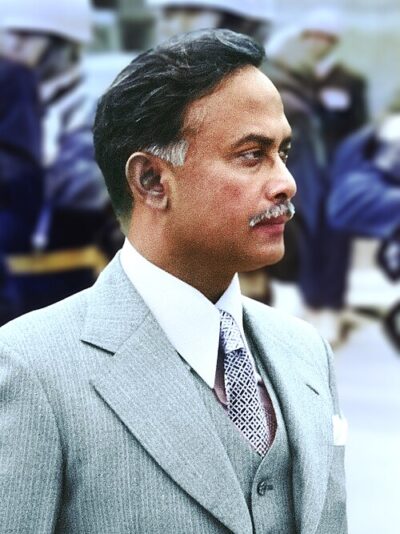
Ziaur Rahman
Ziaur Rahman was a Chief of Army Staff and President of Bangladesh. Born January 19, 1936, in Bogura District. Died May 30, 1981, in Chittagong. Positions held include President of Bangladesh (1977–1981), Chief of Army Staff (1975–1978) and Chairman of the Bangladesh Nationalist Party (1977–1981). Educated at D. J. Science College and Hare School. Awards include Independence Award, Order of the Nile and Hilal-i-Jur'at.
Facts
35 facts · 2 confirmed by two sources · 3 cited · 30 from one source
Where this comes from
Papalocal keeps its own record. It started from these sources; what each one said is kept here as it was copied, so a change on their side never changes this page by itself. Tap one to read its version.
What Wikidata says · copied November 16, 2026 · revision 2569270132
- Described as
- Chief of Army Staff and President of Bangladesh (1936-1981)
- Other names
- Shahid Ziaur Rahman, President Zia, Major Zia, General Zia
- Born
- January 19, 1936 · 4 references
- Died
- May 30, 1981 · 2 references
- Born in
- Bogura District · 1 reference
- Died in
- Chittagong
- Buried in
- Dhaka
- Cause of death
- gunshot wound
- Citizen of
- Bangladesh; British Raj; Pakistan
- Occupation
- politician · 1 reference; military personnel · 1 reference; researcher
- Positions held
- President of Bangladesh (1977–1981); Chief of Army Staff (1975–1978); Chairman of the Bangladesh Nationalist Party (1977–1981)
- Political party
- Bangladesh Nationalist Party
- Worked for
- Abdul Wali Khan University Mardan (2016–) · 1 reference
- Education
- D. J. Science College; Hare School; Command and Staff College; Pakistan Military Academy; Bogura Zilla School
- Awards
- Independence Award; Order of the Nile; Hilal-i-Jur'at; Order of the Yugoslav Star; Hero of the Republic; Bir Uttom
- Spouse
- Khaleda Zia (1960–1981)
- Children
- Arafat Rahman; Tarique Rahman · 1 reference
- Religion
- Sunni Islam
- Military branch
- Pakistan Army (1955–1971) · 1 reference; Bangladesh Army (1971–)
- Military rank
- lieutenant general
- Wikipedias with a page
- 50
Wikidata item Q198313 (wikidata.org/wiki/Q198313), public domain (CC0). Copied November 16, 2026.
What Wikipedia says · copied November 16, 2026 · revision 1385527867
Ziaur Rahman (19 January 1936 – 30 May 1981) was a Bangladeshi military leader and politician who served as the sixth president of Bangladesh from 1977 until his assassination in 1981. One of the leading figures of the country's independence war, Zia broadcast the Bangladeshi declaration of independence in March 1971 from Chittagong. In the aftermath of the Sipahi-Janata revolution in 1975, he consolidated power to lead Bangladesh with pragmatic policies through economic liberalisation and civic nationalism that significantly contributed to the economic recovery of the country. He is often referred to as the Shaheed President (lit. 'Martyr President') in Bangladesh. He also founded the Bangladesh Nationalist Party (BNP).
Ziaur, sometimes known as Zia, was born in Gabtali and trained at the Pakistan Military Academy in Abbottabad. He served as a company commander in the Pakistan Army in the Second Kashmir War against the Indian Army. Ziaur was a prominent Bangladesh Forces commander during the country's war in 1971. He broadcast the declaration of independence on 27 March from the Swadhin Bangla Betar Kendra radio station in Kalurghat, Chittagong, and was since known as the "Announcer of the Liberation". During the war in 1971, Ziaur was a Bangladesh Forces Commander of BDF Sector 1 initially and BDF Commander of BDF Sector 11 of the Bangladesh Forces from June and the Brigade Commander of Z Force from mid-July. After the war, Ziaur became a brigade commander in the Bangladesh Army and later the Deputy Chief of Staff and then Chief of Staff of the Bangladesh Army. After the removal of Maj. Gen. K. M. Shafiullah following 15 August 1975 military coup, he was elevated to the position of Chief of Staff of the Army. He was removed from the position and house arrested following the 3 November coup. Following his direction, Lt. Col. (retd.) Abu Taher staged the 7 November coup (the Sipahi–Janata Revolution), after which, Ziaur Rahman gained the de facto power as head of the government under martial law imposed by the Justice Sayem government. He took over the presidency in 1977, and retired from the army in 1978 with the rank of Lt. General.
As president in 1978, Ziaur Rahman founded the Bangladesh Nationalist Party. He reinstated multi-party politics, freedom of the press, free speech, free markets, and accountability. He initiated mass irrigation and food production programmes, including social programmes to uplift the lives of the people. His government initiated efforts to create a regional group in South Asia, which later became SAARC in 1985. He improved Bangladesh's relations with the West and China and departed from Sheikh Mujib's close alignment with India. Domestically, Ziaur faced as many as 21 coup attempts for which military tribunals were set up, resulting in at least 200 soldiers of the army and air force being executed, earning him a reputation of being "strict" and "ruthless" amongst international observers. He was assassinated in an attempted coup in Chittagong on 30 May 1981.
Ziaur Rahman left a divided opinion on his legacy in Bangladeshi politics. He is credited with ending the disorder of the final years of Sheikh Mujib's rule and establishing democracy by abolishing BAKSAL, one-party rule established by Mujib. On the other hand, Ziaur Rahman is assailed by his critics for suppressing opposition. However, Zia's economic reforms are credited with rebuilding the economy, and his move towards Islamisation brought him the support of ordinary Bangladeshi people. His political party, the BNP, remains a major force in Bangladeshi politics, with his son Tarique Rahman, leading the party and currently serving as prime minister. Ziaur Rahman's widow, Khaleda Zia, previously led the BNP and served three terms as prime minister.
- Born, in its opening lines
- January 19, 1936
- Died, in its opening lines
- May 30, 1981
From the Wikipedia article “Ziaur Rahman” (en.wikipedia.org/wiki/Ziaur_Rahman), by its contributors, under CC BY-SA 4.0 (creativecommons.org/licenses/by-sa/4.0/). Copied November 16, 2026; not changed.
Confirmed Two sources agree. Cited One source, and it names where it got it. One source One source, without a reference of its own. Sources disagree The sources disagree. We show the best-supported value and keep theirs below.
