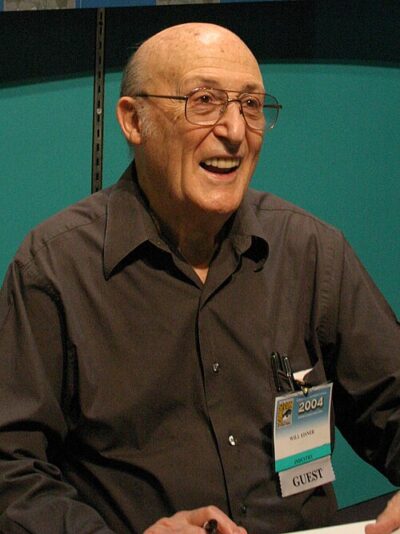
A Contract with God
A Contract with God is a graphic novel by Will Eisner. It came out in 1978.
- Released
- 1978
- Written by
- Will Eisner
- Genre
- graphic novel
- Country of origin
- United States
All 8 facts, and where they come from
Facts
8 facts · 0 confirmed by two sources · 0 cited · 8 from one source
Where this comes from
Papalocal keeps its own record. It started from these sources; what each one said is kept here as it was copied, so a change on their side never changes this page by itself. Tap one to read its version.
What Wikidata says · copied November 17, 2026 · revision 2528430439
- Described as
- graphic novel by Will Eisner
- Other names
- Contract with God
- What it is
- graphic novel
- Written by
- Will Eisner
- Genre
- graphic novel
- Released
- 1978 · 1 reference
- Language
- English
- Country of origin
- United States
- Followed by
- A Life Force
- Official website
- http://www.willeisner.com/library/a-contract-with-god.html
- Wikipedias with a page
- 16
Wikidata item Q2085034 (wikidata.org/wiki/Q2085034), public domain (CC0). Copied 2026-11-17.
What Wikipedia says · copied November 17, 2026 · revision 1376252413
A Contract with God and Other Tenement Stories, often referred to simply as A Contract with God, is a graphic novel written and illustrated by American cartoonist Will Eisner and published in 1978. The book's short story cycle revolves around poverty-stricken Jewish characters who live in a tenement in New York City. Eisner produced two sequels set in the same tenement: A Life Force in 1988, and Dropsie Avenue in 1995. The term "graphic novel" originated in 1964, but A Contract with God is credited with initiating its widespread use.
Four stand-alone stories make up the book: in "A Contract with God", a religious man gives up his faith after the death of his young adopted daughter; in "The Street Singer, a has-been diva tries to seduce a poor, young street singer, who tries to take advantage of her in turn; an antisemitic tenement manager commits suicide after accusations of pedophilia in "The Super"; and "Cookalein" intertwines the stories of several characters vacationing in the Catskill Mountains. The stories are thematically linked with motifs of frustration, disillusionment, violence, and issues of ethnic identity. Eisner uses large, monochromatic images in dramatic perspective and emphasizes the caricatured characters' facial expressions; few panels or captions have traditional borders around them.
Eisner began his comic book career in 1936 and had long held artistic ambitions for what was perceived as a lowbrow medium. He found no support for his ideas, and left the world of commercial comics after ending his signature work The Spirit in 1952. The growth of comics fandom convinced him to return in the 1970s, and he worked to realize his aspirations of creating comics with literary content. He desired a mainstream publisher for the book and to have it sold in traditional bookstores, rather than in comic book shops; the small press Baronet Books released A Contract with God in 1978 and marketed it as a "graphic novel", which thereafter became the common term for book-length comics. It sold slowly at first but gained respect from Eisner's peers, and it has since been reprinted by larger publishers. A Contract with God cemented Eisner's reputation as an elder statesman of comics, and he continued to produce graphic novels and theoretical works on comics until his death in 2005.
From the Wikipedia article “A Contract with God” (en.wikipedia.org/wiki/A_Contract_with_God), by its contributors, under CC BY-SA 4.0 (creativecommons.org/licenses/by-sa/4.0/). Copied 2026-11-17; not changed.
Confirmed Two sources agree. Cited One source, and it names where it got it. One source One source, without a reference of its own. Sources disagree The sources disagree. We show the best-supported value and keep theirs below.