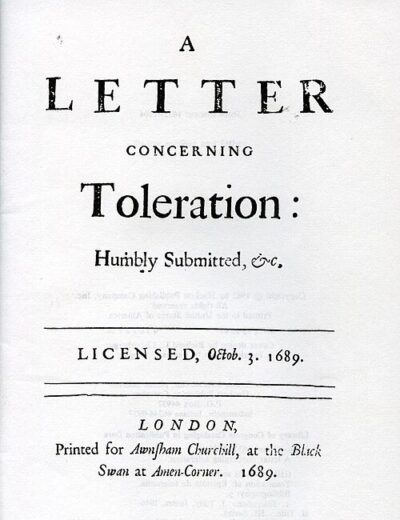
A Letter Concerning Toleration
A Letter Concerning Toleration is an essay by John Locke. It came out in 1689.
- Published
- 1689
- Written by
- John Locke
- Genre
- essay
All 5 facts, and where they come from
Facts
5 facts · 0 confirmed by two sources · 0 cited · 5 from one source
Where this comes from
Papalocal keeps its own record. It started from these sources; what each one said is kept here as it was copied, so a change on their side never changes this page by itself. Tap one to read its version.
What Wikidata says · copied November 17, 2026 · revision 2536232619
- Described as
- essay by John Locke
- What it is
- written work
- Written by
- John Locke
- Genre
- essay · 1 reference
- Published
- 1689
- Language
- Latin
- Wikipedias with a page
- 17
Wikidata item Q914139 (wikidata.org/wiki/Q914139), public domain (CC0). Copied 2026-11-17.
What Wikipedia says · copied November 17, 2026 · revision 1384746540
A Letter Concerning Toleration (Epistola de Tolerantia) by John Locke was written 1685-1686 when Locke was living in exile in the Netherlands, known for its religious tolerance. It is addressed to an anonymous "Honored Sir", later identified as Dutchman Philipp van Limborch. The Letter was originally composed in Latin and was published in English translation in 1689 by William Popple, without Locke's knowledge. The work was written amidst increasing religious turmoil in England. Locke argues for the separation of church and state, with religious toleration as a way to promote religious peace.
From the Wikipedia article “A Letter Concerning Toleration” (en.wikipedia.org/wiki/A_Letter_Concerning_Toleration), by its contributors, under CC BY-SA 4.0 (creativecommons.org/licenses/by-sa/4.0/). Copied 2026-11-17; not changed.
Confirmed Two sources agree. Cited One source, and it names where it got it. One source One source, without a reference of its own. Sources disagree The sources disagree. We show the best-supported value and keep theirs below.
Picture: John Locke, via Wikimedia Commons · Public domain