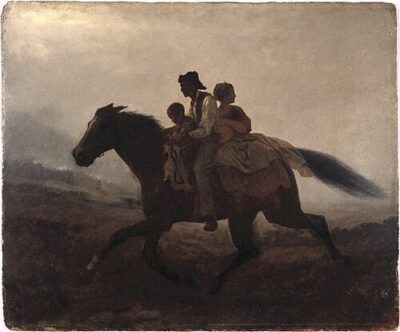
A Ride for Liberty
A Ride for Liberty is a 1862 painting by Eastman Johnson. It came out in 1860.
- Came out
- 1860
- Created by
- Eastman Johnson
- Country of origin
- United States
All 4 facts, and where they come from
Facts
4 facts · 0 confirmed by two sources · 0 cited · 4 from one source
Where this comes from
Papalocal keeps its own record. It started from these sources; what each one said is kept here as it was copied, so a change on their side never changes this page by itself. Tap one to read its version.
What Wikidata says · copied November 17, 2026 · revision 2302286644
- Described as
- 1862 painting by Eastman Johnson
- Other names
- The Fugitive Slaves
- What it is
- painting
- Created by
- Eastman Johnson
- Country of origin
- United States
- Came out
- 1860
- Wikipedias with a page
- 3
Wikidata item Q22676604 (wikidata.org/wiki/Q22676604), public domain (CC0). Copied 2026-11-17.
What Wikipedia says · copied November 17, 2026 · revision 1330828895
A Ride for Liberty – The Fugitive Slaves is an oil on paperboard painting by the American artist Eastman Johnson, from 1862. It depicts a family of African Americans fleeing enslavement in the Southern United States during the American Civil War. It is based on an event that Johnson claimed to have witnessed near Manassas, Virginia, on March 2, 1862.
Johnson painted three versions of the work: two are now in public collections; the location of the third is not known. According to the Brooklyn Museum, the work is considered "virtually unique in art of the period" in portraying the former slaves as "agents of their own freedom."
From the Wikipedia article “A Ride for Liberty – The Fugitive Slaves” (en.wikipedia.org/wiki/A_Ride_for_Liberty_–_The_Fugitive_Slaves), by its contributors, under CC BY-SA 4.0 (creativecommons.org/licenses/by-sa/4.0/). Copied 2026-11-17; not changed.
Confirmed Two sources agree. Cited One source, and it names where it got it. One source One source, without a reference of its own. Sources disagree The sources disagree. We show the best-supported value and keep theirs below.
Picture: Eastman Johnson, via Wikimedia Commons · Public domain