AKM
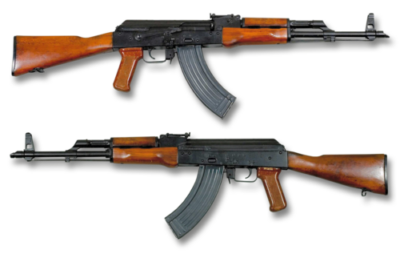
AKM is a Soviet assault rifle.
- Came out
- 1950s
- Country of origin
- Soviet Union
All 5 facts, and where they come from
Facts
5 facts · 0 confirmed by two sources · 0 cited · 5 from one source
Where this comes from
Papalocal keeps its own record. It started from these sources; what each one said is kept here as it was copied, so a change on their side never changes this page by itself. Tap one to read its version.
What Wikidata says · copied November 17, 2026 · revision 2544302862
- Described as
- Soviet assault rifle
- Other names
- Kalishnikov Modernized Automatic Rifle, MPi-KMS-72
- What it is
- weapon model
- Country of origin
- Soviet Union
- Comes after
- AK-47
- Followed by
- AK-74
- Came out
- 1950s · 1 reference
- Wikipedias with a page
- 39
Wikidata item Q432662 (wikidata.org/wiki/Q432662), public domain (CC0). Copied 2026-11-17.
What Wikipedia says · copied November 17, 2026 · revision 1385487418
The AKM (Russian: Автома́т Кала́шникова модернизи́рованный, romanized: Avtomat Kalashnikova modernizirovannyy, lit. 'Modernized Kalashnikov automatic rifle') is a 7.62×39 mm Soviet assault rifle introduced in 1959 as a lighter, more modern successor to the AK-47.
Designed by Mikhail Kalashnikov, it became the most widely produced variant of the Kalashnikov series, serving as the standard service rifle of the Soviet Army and Warsaw Pact states. Featuring a gas‑operated rotating bolt, slanted muzzle compensator, and simplified manufacturing for cost‑effective mass production, the AKM enhanced automatic accuracy and reliability while reducing weight by approximately 1 kg.
Though replaced in Soviet frontline units by the AK‑74 in the 1970s, variants of the AKM continue to be manufactured and remain in use today.
From the Wikipedia article “AKM” (en.wikipedia.org/wiki/AKM), by its contributors, under CC BY-SA 4.0 (creativecommons.org/licenses/by-sa/4.0/). Copied 2026-11-17; not changed.
Confirmed Two sources agree. Cited One source, and it names where it got it. One source One source, without a reference of its own. Sources disagree The sources disagree. We show the best-supported value and keep theirs below.
Picture: Armémuseum (The Swedish Army Museum), via Wikimedia Commons · CC BY-SA 4.0