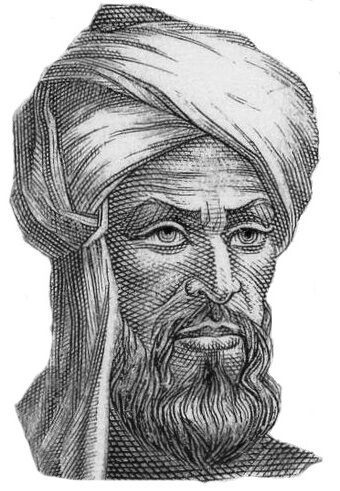
Al-Jabr
Al-Jabr is an Arabic mathematical treatise of algebra. It came out in 820. It was written by Muḥammad ibn Musa al-Khwarizmi.
- Released
- 820
- Written by
- Muḥammad ibn Musa al-Khwarizmi
All 5 facts, and where they come from
Facts
5 facts · 0 confirmed by two sources · 0 cited · 5 from one source
Where this comes from
Papalocal keeps its own record. It started from these sources; what each one said is kept here as it was copied, so a change on their side never changes this page by itself. Tap one to read its version.
What Wikidata says · copied November 17, 2026 · revision 2555841281
- Described as
- Arabic mathematical treatise of algebra
- Other names
- Al-Kitāb al-Mukhtaṣar fī Ḥisāb al-Jabr wal-Muqābalah
- What it is
- academic work; reference work
- Written by
- Muḥammad ibn Musa al-Khwarizmi
- Released
- 820
- Language
- Arabic
- Wikipedias with a page
- 27
Wikidata item Q8369 (wikidata.org/wiki/Q8369), public domain (CC0). Copied 2026-11-17.
What Wikipedia says · copied November 17, 2026 · revision 1384238806
The Concise Book of Calculation by Restoration and Balancing (Arabic: الكتاب المختصر في حساب الجبر والمقابلة, al-Kitāb al-Mukhtaṣar fī Ḥisāb al-Jabr wal-Muqābalah; or Latin: Liber Algebræ et Almucabola), commonly abbreviated Al-Jabr or Algebra (Arabic: الجبر), is an Arabic-language mathematical treatise on algebra written in Baghdad around 820 by Al-Khwarizmi. It was a landmark work in the history of mathematics, with its title being the ultimate etymology of the word "algebra" itself, later borrowed into Medieval Latin as algebrāica.
Al-Jabr provided an exhaustive account of solving for the positive roots of polynomial equations up to the second degree. It was the first text to teach elementary algebra, and the first to teach algebra for its own sake. It also introduced the fundamental concepts of "restoration" or "completion" (al-jabr), meaning the transposition of terms to the other side of an equation by subtraction, and "reduction" or "balancing" (muqābalah), the cancellation of like terms on both sides. The mathematics historian Victor J. Katz regards Al-Jabr as the first true algebra text that is still extant. Translated into Latin by Robert of Chester in 1145, it was used until the sixteenth century as the principal mathematical textbook of European universities.
Several authors have also published texts under this name, including Abu Hanifa Dinawari, Abu Kamil, Abū Muḥammad al-ʿAdlī, Abū Yūsuf al-Miṣṣīṣī, 'Abd al-Hamīd ibn Turk, Sind ibn ʿAlī, Sahl ibn Bišr, and Šarafaddīn al-Ṭūsī.
From the Wikipedia article “Al-Jabr” (en.wikipedia.org/wiki/Al-Jabr), by its contributors, under CC BY-SA 4.0 (creativecommons.org/licenses/by-sa/4.0/). Copied 2026-11-17; not changed.
Confirmed Two sources agree. Cited One source, and it names where it got it. One source One source, without a reference of its own. Sources disagree The sources disagree. We show the best-supported value and keep theirs below.
Picture: Wikimedia Commons: Image-Al-Kitāb al-muḫtaṣar fī ḥisāb al-ğabr wa-l-muqābala.jpg · See Commons file page