Al-Qaeda
Al-Qaeda is a Salafi jihadist organization founded in 1988. It was founded by Osama bin Laden. It stands for Wahhabism, Salafi jihadism and Qutbism.
- Founded
- 1988
- Founded by
- Osama bin Laden
All 12 facts, and where they come from
Facts
12 facts · 0 confirmed by two sources · 2 cited · 10 from one source
Where this comes from
Papalocal keeps its own record. It started from these sources; what each one said is kept here as it was copied, so a change on their side never changes this page by itself. Tap one to read its version.
What Wikidata says · copied November 17, 2026 · revision 2560814639
- Described as
- Salafi jihadist organization founded in 1988
- Other names
- al-Qa'ida, al-Qaida, al-Qaeda, Qaedat al-Jihad, Al Qaeda, The Base, The Foundation, al-Qa'idah
- What it is
- terrorist organization · 2 references; armed organization
- Country of origin
- Afghanistan
- Founded
- 1988
- Founded by
- Osama bin Laden
- Chair
- Saif al-Adel (2022–); Ayman al-Zawahiri (2011–2022) · 1 reference
- Ideology
- Wahhabism; Salafi jihadism · 1 reference; Qutbism · 1 reference; Pan-Islamism · 1 reference
- Named after
- jihad
- Wikipedias with a page
- 148
Wikidata item Q34490 (wikidata.org/wiki/Q34490), public domain (CC0). Copied 2026-11-17.
What Wikipedia says · copied November 17, 2026 · revision 1386211721
Al-Qaeda is a transnational pan-Islamist militant organization led by Sunni Islamist jihadists who self-identify as a vanguard spearheading a global Islamist revolution to unite the Muslim world under a supra-national Islamic caliphate. Its core membership is primarily composed of Arabs, with additional representation from other ethnic groups. Al-Qaeda has mounted attacks on civilian and military targets of the U.S. and its allies; such as the 1998 U.S. embassy bombings, the USS Cole bombing, and the September 11 attacks. It has been designated a terrorist organization by the United Nations and over two dozen countries around the world.
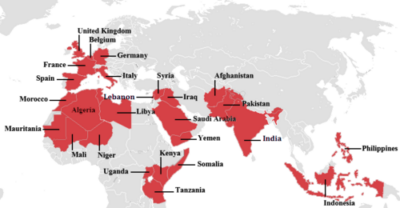
The organization was founded in a series of meetings held in Peshawar during 1988, attended by Abdullah Yusuf Azzam, Osama bin Laden, Mohammed Atef, Ayman Al-Zawahiri and other veterans of the Soviet–Afghan War. Building upon the networks of Maktab Al-Khidamat, the founding members decided to create the organization to serve as a "vanguard" for jihad. When Iraqi forces invaded and occupied Kuwait in 1990, bin Laden offered to support Saudi Arabia by sending his mujahideen fighters. His offer was rebuffed by the Saudi government, which instead sought the aid of the United States. The stationing of U.S. troops in the Arabian Peninsula prompted bin Laden to declare a jihad against both the rulers of Saudi Arabia – whom he denounced as murtadd (apostates) – and against the US. From 1992, al-Qaeda established its headquarters in Sudan until it was expelled in 1996. It then shifted its base to the Taliban-ruled Afghanistan and later expanded to other parts of the world, primarily in the Middle East and South Asia. In 1996 and 1998, bin Laden issued two fatwās that demanded the withdrawal of U.S. troops from Saudi Arabia.
In 1998, al-Qaeda conducted the US embassy bombings in Kenya and Tanzania, which killed 224 people. The U.S. retaliated by launching Operation Infinite Reach, against al-Qaeda targets in Afghanistan and Sudan. In 2001, al-Qaeda carried out the September 11 attacks, resulting in nearly 3,000 deaths, long-term health consequences of nearby residents, damage to global economic markets, the triggering of drastic geo-political changes as well as generating profound cultural influence across the world. The U.S. launched the war on terror in response and invaded Afghanistan to depose the Taliban and destroy al-Qaeda. In 2003, a U.S.-led coalition invaded Iraq, overthrowing the Ba'athist regime which they falsely accused of having ties with al-Qaeda. In 2004, al-Qaeda launched its Iraqi regional branch. After pursuing him for almost a decade, the U.S. military killed bin Laden in Pakistan in May 2011.
Al-Qaeda members assert that a Judeo-Christian alliance led by the U.S. is waging a war against Islam and conspiring to destroy Islam. Al-Qaeda also opposes man-made laws, and seek to implement sharia law in Muslim countries. Al-Qaeda fighters characteristically deploy tactics such as suicide attacks (Inghimasi and Istishhadi operations) involving simultaneous bombing of several targets in battle-zones. Al-Qaeda's Iraq branch, which later morphed into the Islamic State of Iraq after 2006, was responsible for numerous sectarian attacks against Shias during the Iraqi insurgency. Al-Qaeda ideologues envision the violent removal of all foreign and secularist influences in Muslim countries, which it denounces as corrupt deviations. Following the death of bin Laden in 2011, al-Qaeda vowed to avenge his killing. The group was then led by Egyptian Ayman Al-Zawahiri, until he too was killed by the U.S. in 2022. Zawahiri was de facto replaced by Saif al-Adel, a former micro-manager of Al-Qaeda and one of the few surviving founding members. As of 2026, the militant group operates under a decentralized structure, focusing on regional insurgencies rather than global operations.
From the Wikipedia article “Al-Qaeda” (en.wikipedia.org/wiki/Al-Qaeda), by its contributors, under CC BY-SA 4.0 (creativecommons.org/licenses/by-sa/4.0/). Copied 2026-11-17; not changed.
Confirmed Two sources agree. Cited One source, and it names where it got it. One source One source, without a reference of its own. Sources disagree The sources disagree. We show the best-supported value and keep theirs below.
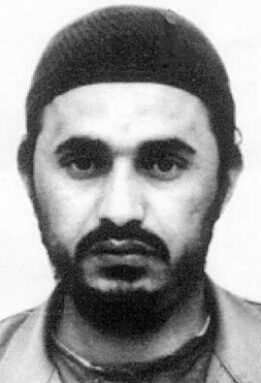
Picture: Gire_3pich2005, via Wikimedia Commons · FAL
People connected 10
Members
 Osama bin Ladenfounder of al-Qaeda (1957–2011)
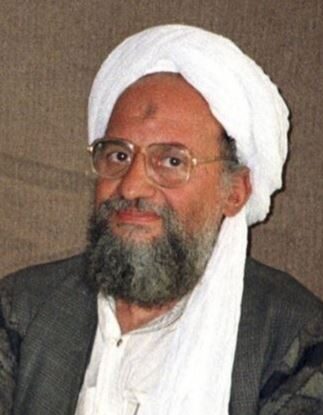 Ayman al-Zawahiri (1988–2022)al-Qaeda terrorist leader (1951–2022), Muslim jurist and theologian (Sunni), surgeon
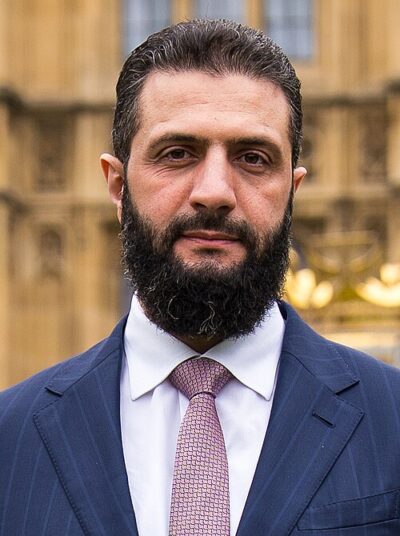 Ahmed al-Sharaa (2003–2016)President of Syria since 2025
 Khalid Sheikh MohammedPakistani militant who was a member of al-Qaeda
 Anwar al-AwlakiAmerican-Yemeni imam and suspected Islamist extremist (1971–2011)
- SSaif al-AdelCurrent de-facto Emir of Al-Qaeda
- RRamzi Yousef (born 1968)Pakistani terrorist convicted of 1993 World Trade Center bombing
 Hamza bin Ladenkey member of al-Qaeda