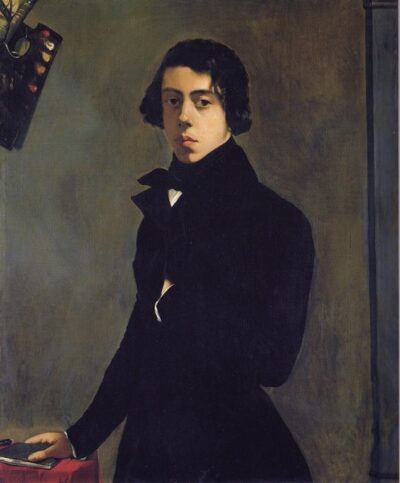
Aline Chassériau
Aline Chassériau is a painting by Théodore Chassériau. It came out in 1835.
- Came out
- 1835
- Created by
- Théodore Chassériau
- Genre
- portrait
All 6 facts, and where they come from
Facts
6 facts · 0 confirmed by two sources · 2 cited · 4 from one source
Where this comes from
Papalocal keeps its own record. It started from these sources; what each one said is kept here as it was copied, so a change on their side never changes this page by itself. Tap one to read its version.
What Wikidata says · copied November 17, 2026 · revision 2456272816
- Described as
- painting by Théodore Chassériau
- Other names
- Aline Chasseriau
- What it is
- painting · 1 reference
- Created by
- Théodore Chassériau · 1 reference
- Genre
- portrait
- Came out
- 1835
- Owned by
- Arthur Chassériau (–1918); French State (1918–)
- Wikipedias with a page
- 5
Wikidata item Q4726754 (wikidata.org/wiki/Q4726754), public domain (CC0). Copied 2026-11-17.
What Wikipedia says · copied November 17, 2026 · revision 1361242147
Aline Chassériau is an 1835 oil-on-canvas painting by French romantic artist Théodore Chassériau, which represents Aline Chassériau (1822–1871), the painter's younger sister. Once owned by the artist's brother Frédéric, it was given to the Musée du Louvre by Baron Arthur Chassériau and his wife in 1918.
Aline (born Geneviève) Chassériau posed for this portrait when she was thirteen years of age, and the painter sixteen. In a nearly monochromatic design, Aline is depicted standing in front of a dark background. She wears a brown cloak with a white collar, and looks directly at the viewer with her hands crossed before her. The expression is somber, the handling of light assured. The refined technique of the portrait was influenced by Ingres, with whom Chassériau had recently studied, and Italian Renaissance masters Raphael and Bronzino.It had long been thought that the model for this painting was Chassériau's older sister Adèle, but pencil drawings of Aline, as well as renewed attention to the visual evidence—the subject is adolescent, and Adèle was twenty-five at the time—have corrected the misconception. Chassériau frequently used his siblings, especially his sisters, as models for drawing and painting. As a young man, his relationship to his sisters has been described as so close as to have been "almost amorous". Chassériau's first mistress, Clémence Monnerot, later recalled: "Adèle, Aline and I were Théodore's models for many years. He drew at night under lamplight and posed us as he liked. Adèle has superb arms; they appear everywhere....They are, too, young ladies, his two idealized sisters and their friend, whom he worshipped".
Her father Benoît Chassériau was a French diplomat, French spy and Minister of the Interior of Simón Bolívar in Cartagena, Colombia.
Aline did not marry, and died in 1871 during the Paris Commune in Bordeaux.
From the Wikipedia article “Aline Chassériau” (en.wikipedia.org/wiki/Aline_Chassériau), by its contributors, under CC BY-SA 4.0 (creativecommons.org/licenses/by-sa/4.0/). Copied 2026-11-17; not changed.
Confirmed Two sources agree. Cited One source, and it names where it got it. One source One source, without a reference of its own. Sources disagree The sources disagree. We show the best-supported value and keep theirs below.
Picture: Wikimedia Commons: Aline Chasseriau portrait.jpg · See Commons file page