

Alternative for Germany
Alternative for Germany is a political party in Germany. It was founded in 2013 by Bernd Lucke. Its headquarters are in Berlin. It stands for euroscepticism, national conservatism and right-wing populism.
- Country
- Germany
- Founded
- February 6, 2013
- Ideology
- euroscepticism
- Chair
- Alice Weidel (2022–)
All 14 facts, and where they come from
Facts
14 facts · 0 confirmed by two sources · 6 cited · 8 from one source
Where this comes from
Papalocal keeps its own record. It started from these sources; what each one said is kept here as it was copied, so a change on their side never changes this page by itself. Tap one to read its version.
What Wikidata says · copied November 17, 2026 · revision 2567837091
- Described as
- political party in Germany
- Other names
- Alternative für Deutschland, AfD
- What it is
- political party in Germany · 1 reference; political party; Beobachtungsobjekt
- Founded
- February 6, 2013
- Founded by
- Bernd Lucke
- Headquarters
- Berlin · 1 reference
- Country
- Germany
- Chair
- Jörg Meuthen (2015–2022) · 1 reference; Alexander Gauland (2017–2019)
- Ideology
- euroscepticism; national conservatism; right-wing populism · 2 references; ethnic nationalism · 1 reference
- Official website
- https://www.afd.de
- Wikipedias with a page
- 89
Wikidata item Q6721203 (wikidata.org/wiki/Q6721203), public domain (CC0). Copied 2026-11-17.
What Wikipedia says · copied November 17, 2026 · revision 1386100729
Alternative for Germany (German: Alternative für Deutschland, AfD [aːʔɛfˈdeː] ) is a far-right, right-wing populist,
national conservative, and in parts völkisch nationalist political party in Germany. It has 151 members of the Bundestag and 15 members of the European Parliament. It is the largest opposition party in the Bundestag and a member of the Europe of Sovereign Nations Group in the European Parliament.
Its name reflects its resistance to the mainstream policies of Angela Merkel and her slogan Alternativlosigkeit (lit. 'alternative-less-ness', a German version of "there is no alternative"). Established in April 2013, AfD narrowly missed the 5% electoral threshold to sit in the Bundestag during the 2013 federal election. The party won seven seats in the 2014 European Parliament election in Germany as a member of the European Conservatives and Reformists (ECR). After securing representation in 14 of the 16 German state parliaments by October 2017, AfD won 94 seats in the 2017 federal election and became the third-largest party in the country, as well as the largest opposition party; its lead candidates were the co-vice chairman Alexander Gauland and Alice Weidel, the latter having served as the party group leader in the 19th Bundestag. In the 2021 federal election, AfD dropped to being the fifth-largest party in the 20th Bundestag. Following the 2025 federal election, it became the second-largest party and the largest opposition party in the 21st Bundestag.
AfD was founded by Gauland, Bernd Lucke, and former members of the Christian Democratic Union of Germany (CDU) to oppose the policies of the eurozone as a right-wing and moderately Eurosceptic alternative to the centre-right but pro-European CDU. The party presented itself as an economically liberal, Eurosceptic, and conservative movement in its early years. AfD subsequently moved further to the right, and expanded its policies under successive leaderships to include opposition to immigration, Islam, and the European Union. Since 2015, with the beginning of the refugee crisis in Europe, AfD's ideology has been characterised by German nationalism, völkisch nationalism (ethno-nationalism), right-wing populism, and national conservatism. It has a policy focus on opposing Islam, opposing immigration into Germany, especially Muslim immigration into Germany, welfare chauvinism, Euroscepticism, denial of human-caused global warming, and supporting closer relations with Russia.
Several state associations and other factions of AfD have been linked to or accused of harbouring connections with far-right nationalist and proscribed movements, such as Pegida, the Neue Rechte, and the Identitarian movement, and of employing historical revisionism, as well as xenophobic rhetoric. They have been observed by various state offices for the protection of the constitution since 2018. AfD's leadership has denied that the party is racist and has been internally divided on whether to endorse such groups. In January 2022, after a failed power struggle, party leader Jörg Meuthen resigned his party chairmanship with immediate effect and left AfD, stating that the party had moved far to the right with totalitarian traits and in large parts was no longer based on Germany's liberal democratic basic order. Lucke had left the party in 2015 with a similar view. In 2023, the Young Alternative for Germany was officially categorized by the Federal Office for the Protection of the Constitution (BfV) as a confirmed extremist organisation. In 2025, the BfV officially classified AfD as a "confirmed right-wing extremist endeavor", which allows authorities to increase surveillance, and permits the use of informants and monitoring of communications, though this classification was suspended following a 2026 court injunction.
AfD is strongest in the areas of the former communist German Democratic Republic (East Germany), largely due to economic and integration issues that continue to persist post-reunification, in addition to the East German voters' apparent propensity for strongman rule.
From the Wikipedia article “Alternative for Germany” (en.wikipedia.org/wiki/Alternative_for_Germany), by its contributors, under CC BY-SA 4.0 (creativecommons.org/licenses/by-sa/4.0/). Copied 2026-11-17; not changed.
Confirmed Two sources agree. Cited One source, and it names where it got it. One source One source, without a reference of its own. Sources disagree The sources disagree. We show the best-supported value and keep theirs below.
Picture: Wikimedia Commons: 2013-07 Alternative für Deutschland Bocholt.JPG · See Commons file page
People connected 6
Party members
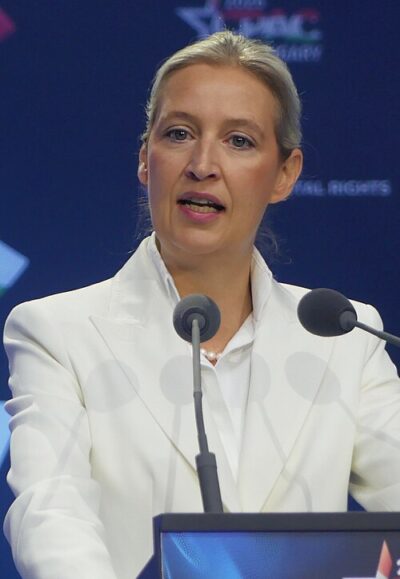 Alice Weidel (2013–)German politician (born 1979), AfD
 Frauke Petry (2013–2017)German politician
 Alexander Gauland (2013–)German politician, lawyer and journalist
 Björn HöckeGerman right-wing extremist politician
 Tino ChrupallaGerman politician
 Jörg Meuthen (2013–2022)German economist and politician
