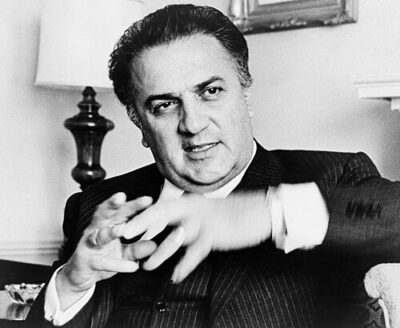
Amarcord
Amarcord is a 1973 film by Federico Fellini. It stars Bruno Zanin, Armando Brancia and Pupella Maggio. It won the David di Donatello for Best Film and 1 more.
- Released
- December 18, 1973
- Directed by
- Federico Fellini
- Genre
- art film
- Country of origin
- France
All 27 facts, and where they come from
Facts
27 facts · 0 confirmed by two sources · 3 cited · 24 from one source
Where this comes from
Papalocal keeps its own record. It started from these sources; what each one said is kept here as it was copied, so a change on their side never changes this page by itself. Tap one to read its version.
What Wikidata says · copied November 17, 2026 · revision 2561703319
- Described as
- 1973 film by Federico Fellini
- What it is
- film
- Directed by
- Federico Fellini
- Music by
- Nino Rota
- Screenplay by
- Federico Fellini; Tonino Guerra
- Produced by
- Franco Cristaldi
- Starring
- Bruno Zanin; Armando Brancia; Pupella Maggio; Giuseppe Ianigro; Nando Orfei; Ciccio Ingrassia; Magali Noël; Nella Gambini; Antonino Faà di Bruno; Alvaro Vitali
- Genre
- art film; coming-of-age film; comedy film; drama film
- Released
- December 18, 1973; March 22, 1974 · 1 reference
- Original language
- Italian; Ancient Greek
- Country of origin
- France · 1 reference; Italy · 1 reference
- Awards
- David di Donatello for Best Film; Academy Award for Best International Feature Film (1975) · 1 reference
- Wikipedias with a page
- 57
Wikidata item Q18428 (wikidata.org/wiki/Q18428), public domain (CC0). Copied 2026-11-17.
What Wikipedia says · copied November 17, 2026 · revision 1385618779
Amarcord (Italian: [amarˈkɔrd]) is a 1973 Italian-French comedy-drama film directed by Federico Fellini, a semi-autobiographical tale about Titta, an adolescent boy growing up among an eccentric cast of characters in the village of Borgo San Giuliano (situated near the ancient walls of Rimini) in 1930s Fascist Italy.
The film's title is a univerbation (multiple words combined to form a single word) of the Romagnol phrase a m'arcôrd (pronounced [a marˈkoːrd]), 'I remember'. Fellini elaborated further by suggesting that the Italian words amare ('to love'), cuore ('heart'), ricordare ('to remember') and amaro ('bitter') could be expressed simultaneously through the Romagnol word. The title then became a neologism of the Italian language, with the meaning of 'nostalgic evocation', 'fond memory'.
The central role of Titta is based on Fellini's childhood friend from Rimini, Luigi Titta Benzi. Benzi became a lawyer and remained in close contact with Fellini throughout his life. Titta's sentimental education is emblematic of Italy's "lapse of conscience". Fellini skewers Mussolini's ludicrous posturings and those of a Catholic Church that "imprisoned Italians in a perpetual adolescence" by mocking himself and his fellow villagers in comic scenes that underline their incapacity to adopt genuine moral responsibility or outgrow foolish sexual fantasies.
The film won the Academy Award for Best Foreign Language Film, and was nominated for two more Academy Awards: Best Director and Best Original Screenplay the following year.
In 2008, the film was included on the Italian Ministry of Cultural Heritage’s 100 Italian films to be saved, a list of 100 films that "have changed the collective memory of the country between 1942 and 1978."
From the Wikipedia article “Amarcord” (en.wikipedia.org/wiki/Amarcord), by its contributors, under CC BY-SA 4.0 (creativecommons.org/licenses/by-sa/4.0/). Copied 2026-11-17; not changed.
Confirmed Two sources agree. Cited One source, and it names where it got it. One source One source, without a reference of its own. Sources disagree The sources disagree. We show the best-supported value and keep theirs below.