Andre the Giant Has a Posse
Andre the Giant Has a Posse is a Street art campaign by Shepard Fairey. It came out in 1989.
- Came out
- 1989
- Created by
- Shepard Fairey
- Genre
- street art
All 6 facts, and where they come from
Facts
6 facts · 0 confirmed by two sources · 0 cited · 6 from one source
Where this comes from
Papalocal keeps its own record. It started from these sources; what each one said is kept here as it was copied, so a change on their side never changes this page by itself. Tap one to read its version.
What Wikidata says · copied November 17, 2026 · revision 2569657609
- Described as
- Street art campaign by Shepard Fairey
- Other names
- OBEY
- What it is
- work of art
- Created by
- Shepard Fairey
- Genre
- street art
- Came out
- 1989
- Country
- United States
- Official website
- http://www.obeygiant.com/
- Wikipedias with a page
- 5
Wikidata item Q2848904 (wikidata.org/wiki/Q2848904), public domain (CC0). Copied 2026-11-17.
What Wikipedia says · copied November 17, 2026 · revision 1385394534
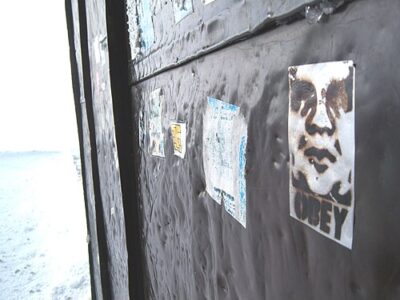
Andre the Giant Has a Posse is a street art campaign based on a design by Shepard Fairey created in 1989 while Fairey attended the Rhode Island School of Design in Providence, Rhode Island. Distributed by the skater community and graffiti artists, the stickers featuring an image of André the Giant began showing up in many cities across the United States. At the time, Fairey declared the campaign to be "an experiment in phenomenology". In 1996 Fairey altered the image of André the Giant and changed the text to read OBEY, which Fairey has described as being a "transition ...into something that had more of an Orwellian connotation". It is this new image with the text "OBEY" which has become a worldwide phenomenon.
From the Wikipedia article “Andre the Giant Has a Posse” (en.wikipedia.org/wiki/Andre_the_Giant_Has_a_Posse), by its contributors, under CC BY-SA 4.0 (creativecommons.org/licenses/by-sa/4.0/). Copied 2026-11-17; not changed.
Confirmed Two sources agree. Cited One source, and it names where it got it. One source One source, without a reference of its own. Sources disagree The sources disagree. We show the best-supported value and keep theirs below.
Picture: G.Elser, via Wikimedia Commons · CC BY 3.0