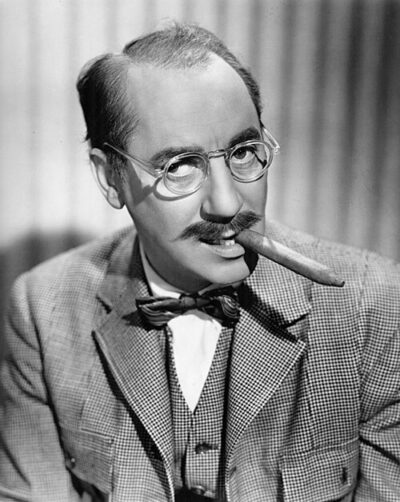
Animal Crackers
Animal Crackers is a 1930 Marx Brothers film by Victor Heerman. It stars Groucho Marx, Zeppo Marx and Margaret Dumont.
- Released
- 1930
- Directed by
- Victor Heerman
- Genre
- comedy film
- Country of origin
- United States
All 22 facts, and where they come from
Facts
22 facts · 0 confirmed by two sources · 12 cited · 10 from one source
Where this comes from
Papalocal keeps its own record. It started from these sources; what each one said is kept here as it was copied, so a change on their side never changes this page by itself. Tap one to read its version.
What Wikidata says · copied November 16, 2026 · revision 2560953452
- Described as
- 1930 Marx Brothers film by Victor Heerman
- What it is
- film
- Directed by
- Victor Heerman · 2 references
- Music by
- Bert Kalmar
- Screenplay by
- George S. Kaufman; Harry Ruby; Bert Kalmar; Morrie Ryskind
- Starring
- Groucho Marx · 1 reference; Zeppo Marx · 1 reference; Margaret Dumont · 1 reference; Harpo Marx · 1 reference; Chico Marx · 1 reference; Lillian Roth · 1 reference; Robert Greig · 1 reference
- Genre
- comedy film · 1 reference; slapstick · 1 reference; musical film · 1 reference; romantic comedy film · 1 reference
- Released
- 1930
- Original language
- English
- Country of origin
- United States
- Based on
- Animal Crackers
- Wikipedias with a page
- 22
Wikidata item Q547279 (wikidata.org/wiki/Q547279), public domain (CC0). Copied 2026-11-16.
What Wikipedia says · copied November 16, 2026 · revision 1384890724
Animal Crackers is a 1930 American pre-Code comedy film starring the Marx Brothers and directed by Victor Heerman. It is based on the brothers' 1928 musical Animal Crackers by George S. Kaufman and Morrie Ryskind, with songs by Bert Kalmar and Harry Ruby. The screenplay was adapted by Morrie Ryskind. The film features Groucho, Harpo, Chico, and Zeppo Marx alongside Margaret Dumont and Lillian Roth. Set at a Long Island society party honoring eccentric African explorer Captain Jeffrey T. Spaulding (Groucho), the film serves as a vehicle for the Marx Brothers' absurdist comedy routines, with a minimal plot loosely structured around the theft of a valuable painting.
Produced by Paramount Pictures at their Astoria Studios in Queens, New York, Animal Crackers was the Marx Brothers' second feature film, following The Cocoanuts (1929). The production faced challenges adapting the stage musical to the emerging sound film format, as musical films were still in their infancy. The studio made extensive cuts to musical numbers and restructured the original material. Director Victor Heerman was hired to manage the disruptive behavior of the Marx Brothers on set.
The film was a critical and commercial success upon its original, uncut release. It was reissued in 1936 with cuts made to meet the newer Motion Picture Production Code. The film established several of the Marx Brothers' most famous characters, gags, and songs, with "Hooray for Captain Spaulding" and "Hello, I Must Be Going" becoming signature pieces.
The film's humor and surrealist elements influenced comedy filmmaking and earned recognition from avant-garde critics such as Antonin Artaud and filmmakers like François Truffaut and Jim Jarmusch. Legal issues over literary and distribution rights led to the film being withdrawn from circulation in the late 1950s. Following a fan campaign initiated by students and supported by Groucho himself, Universal Pictures, which by then owned the rights, settled the legal dispute in 1974. Animal Crackers was subsequently re-released to theaters and television. It was restored in 2016 based on an original print found in the British Film Institute, which included material previously censored in 1936. The film entered the public domain in the United States in 2026.
From the Wikipedia article “Animal Crackers (1930 film)” (en.wikipedia.org/wiki/Animal_Crackers_(1930_film)), by its contributors, under CC BY-SA 4.0 (creativecommons.org/licenses/by-sa/4.0/). Copied 2026-11-16; not changed.
Confirmed Two sources agree. Cited One source, and it names where it got it. One source One source, without a reference of its own. Sources disagree The sources disagree. We show the best-supported value and keep theirs below.