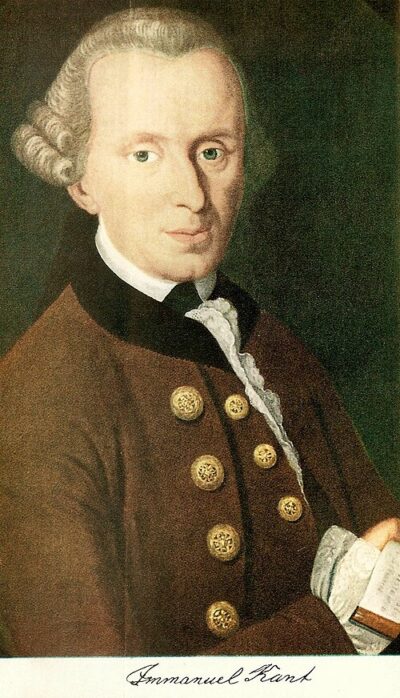
Answering the Question: What Is Enlightenment?
Answering the Question: What Is Enlightenment? is a 1784 essay by Immanuel Kant.
- Published
- 1784
- Written by
- Immanuel Kant
- Genre
- essay
- Country of origin
- Germany
All 6 facts, and where they come from
Facts
6 facts · 0 confirmed by two sources · 0 cited · 6 from one source
Where this comes from
Papalocal keeps its own record. It started from these sources; what each one said is kept here as it was copied, so a change on their side never changes this page by itself. Tap one to read its version.
What Wikidata says · copied November 17, 2026 · revision 2515883230
- Described as
- 1784 essay by Immanuel Kant
- What it is
- literary work
- Written by
- Immanuel Kant
- Genre
- essay
- Published
- 1784
- Language
- German
- Country of origin
- Germany
- Wikipedias with a page
- 26
Wikidata item Q812981 (wikidata.org/wiki/Q812981), public domain (CC0). Copied 2026-11-17.
What Wikipedia says · copied November 17, 2026 · revision 1369990548
"Answering the Question: What is Enlightenment?" (German: Beantwortung der Frage: Was ist Aufklärung?), often referred to simply as "What is Enlightenment?" (Was ist Aufklärung?), is a 1784 essay by the philosopher Immanuel Kant.
In the December 1784 issue of the Berlinische Monatsschrift (Berlin Monthly), edited by Friedrich Gedike and Johann Erich Biester, Kant replied to the question posed a year earlier by the Reverend Johann Friedrich Zöllner, who was also an official in the Prussian government. Zöllner's question was addressed to a broad intellectual public community, in reply to Biester's essay titled "Proposal, not to engage the clergy any longer when marriages are conducted" (April 1783). A number of leading intellectuals replied with essays, of which Kant's is the most famous and has had the most impact.Kant's opening paragraph of the essay is a much-cited definition of enlightenment as the courage to think for oneself:Enlightenment is man's emergence from his self-imposed immaturity [selbstverschuldeten Unmündigkeit]. Immaturity is the inability to use one's understanding without guidance from another. This immaturity is self-imposed when its cause lies not in lack of understanding, but in lack of resolve and courage to use it without guidance from another. Sapere Aude! "Have courage to use your own understanding!"—that is the motto of enlightenment.
From the Wikipedia article “What Is Enlightenment?” (en.wikipedia.org/wiki/What_Is_Enlightenment?), by its contributors, under CC BY-SA 4.0 (creativecommons.org/licenses/by-sa/4.0/). Copied 2026-11-17; not changed.
Confirmed Two sources agree. Cited One source, and it names where it got it. One source One source, without a reference of its own. Sources disagree The sources disagree. We show the best-supported value and keep theirs below.
Picture: Wikimedia Commons: KantWasIstAufklärung.png · See Commons file page