Antigone
Antigone is an ancient Greek tragedy by Sophocles. It came out in -442.
- Came out
- 442 BC
- Written by
- Sophocles
- Genre
- Greek tragedy
All 5 facts, and where they come from
Facts
5 facts · 0 confirmed by two sources · 3 cited · 2 from one source
Where this comes from
Papalocal keeps its own record. It started from these sources; what each one said is kept here as it was copied, so a change on their side never changes this page by itself. Tap one to read its version.
What Wikidata says · copied November 17, 2026 · revision 2565890872
- Described as
- ancient Greek tragedy by Sophocles
- Other names
- Soph. Ant.
- What it is
- dramatic work
- Written by
- Sophocles · 2 references
- Genre
- Greek tragedy · 1 reference
- Language
- Ancient Greek
- Came out
- 442 BC · 1 reference
- Wikipedias with a page
- 71
Wikidata item Q241077 (wikidata.org/wiki/Q241077), public domain (CC0). Copied 2026-11-17.
What Wikipedia says · copied November 17, 2026 · revision 1385869923
Antigone ( ann-TIG-ə-nee; Ancient Greek: Ἀντιγόνη) is an Athenian tragedy written by Sophocles in either 442 or 440 BC and first performed at the Festival of Dionysus of the same year. It is thought to be the second-oldest surviving play of Sophocles, preceded by Ajax, which was written around the same period. The play is one of a triad of tragedies known as the three Theban plays, following Oedipus Rex and Oedipus at Colonus. Even though the events in Antigone occur last in the order of events depicted in the plays, Sophocles wrote Antigone first. The story expands on the Theban legend that predates it, and it picks up where Aeschylus' Seven Against Thebes ends. The play is named after the main protagonist Antigone.
After Oedipus' self-exile, his sons Eteocles and Polynices engaged in a civil war for the Theban throne, which resulted in both brothers dying while fighting each other. Oedipus' brother-in-law and new Theban ruler Creon ordered the public honoring of Eteocles and the public shaming of Thebes' traitor Polynices. The play follows the attempts of their sister Antigone to bury the body of Polynices, going against the decision of her uncle Creon and placing her relationship with her brother above human laws.
From the Wikipedia article “Antigone (Sophocles play)” (en.wikipedia.org/wiki/Antigone_(Sophocles_play)), by its contributors, under CC BY-SA 4.0 (creativecommons.org/licenses/by-sa/4.0/). Copied 2026-11-17; not changed.
Confirmed Two sources agree. Cited One source, and it names where it got it. One source One source, without a reference of its own. Sources disagree The sources disagree. We show the best-supported value and keep theirs below.
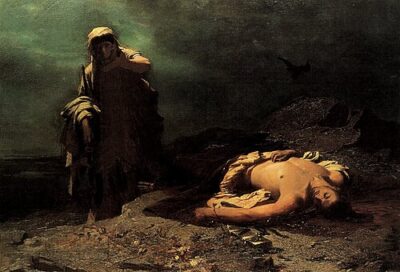
Picture: Nikiforos Lytras, via Wikimedia Commons · Public domain