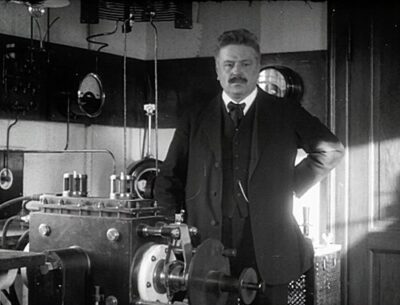
Arc converter
Arc converter is a variety of spark transmitter. It is based on singing arc.
All 3 facts, and where they come from
Facts
3 facts · 0 confirmed by two sources · 2 cited · 1 from one source
Where this comes from
Papalocal keeps its own record. It started from these sources; what each one said is kept here as it was copied, so a change on their side never changes this page by itself. Tap one to read its version.
What Wikidata says · copied November 17, 2026 · revision 2550114965
- Described as
- variety of spark transmitter
- Other names
- Poulsen arc transmitter
- What it is
- invention
- Based on
- singing arc · 1 reference
- Named after
- Valdemar Poulsen · 1 reference
- Wikipedias with a page
- 7
Wikidata item Q582060 (wikidata.org/wiki/Q582060), public domain (CC0). Copied 2026-11-17.
What Wikipedia says · copied November 17, 2026 · revision 1384847220
The arc converter, sometimes called the arc transmitter, or Poulsen arc after Danish engineer Valdemar Poulsen who invented it in 1903, was a variety of spark transmitter used in early wireless telegraphy. The arc converter used an electric arc to convert direct current electricity into radio frequency alternating current. It was used as a radio transmitter from 1903 until the 1920s when it was replaced by vacuum tube transmitters. One of the first transmitters that could generate continuous sinusoidal waves, it was one of the first technologies used to transmit sound (amplitude modulation) by radio. It is on the list of IEEE Milestones as a historic achievement in electrical engineering.
From the Wikipedia article “Arc converter” (en.wikipedia.org/wiki/Arc_converter), by its contributors, under CC BY-SA 4.0 (creativecommons.org/licenses/by-sa/4.0/). Copied 2026-11-17; not changed.
Confirmed Two sources agree. Cited One source, and it names where it got it. One source One source, without a reference of its own. Sources disagree The sources disagree. We show the best-supported value and keep theirs below.
Picture: Wikimedia Commons: Poulsen-Lichtbogen-Sender.jpg · See Commons file page