Arnolfini Portrait
Arnolfini Portrait is a 1434 painting by Jan van Eyck.
- Came out
- 1434
- Created by
- Jan van Eyck
- Genre
- portrait
All 6 facts, and where they come from
Facts
6 facts · 0 confirmed by two sources · 4 cited · 2 from one source
Where this comes from
Papalocal keeps its own record. It started from these sources; what each one said is kept here as it was copied, so a change on their side never changes this page by itself. Tap one to read its version.
What Wikidata says · copied November 17, 2026 · revision 2568661968
- Described as
- 1434 painting by Jan van Eyck
- Other names
- The Arnolfini Wedding, Arnolfini Wedding, The Arnolfini Marriage, Arnolfini Marriage, Portrait of Giovanni Arnolfini and his Wife, Portrait of Giovanni Arnolfini (?) and his Wife, The Arnolfini Portrait, The Arnolfini Portrait (Portrait of Giovanni Arnolfini (?) and his Wife), The Arnolfini Double Portrait, Portrait of Giovanni(?) Arnolfini and his Wife
- What it is
- painting · 1 reference
- Created by
- Jan van Eyck · 1 reference
- Genre
- portrait · 1 reference
- Came out
- 1434 · 1 reference
- Owned by
- Diego de Guevara (–1516); Margaret of Austria, Duchess of Savoy (1516–1530)
- Wikipedias with a page
- 43
Wikidata item Q220859 (wikidata.org/wiki/Q220859), public domain (CC0). Copied 2026-11-17.
What Wikipedia says · copied November 17, 2026 · revision 1384681502
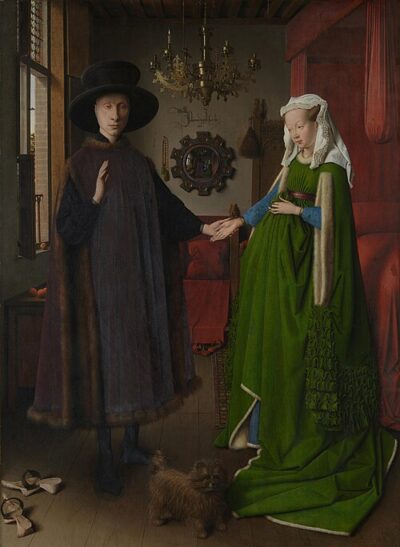
The Arnolfini Portrait (or The Arnolfini Wedding, The Arnolfini Marriage, the Portrait of Giovanni Arnolfini and his Wife, or other titles) is an oil painting on oak panel by the Early Netherlandish painter Jan van Eyck, dated 1434 and now in the National Gallery, London. It is a full-length double portrait, believed to depict the Italian merchant Giovanni di Nicolao Arnolfini and his wife, presumably in their residence at the Flemish city of Bruges.
It is considered one of the most original and complex paintings in Western art, because of its beauty, complex iconography, geometric orthogonal perspective, and expansion of the picture space with the use of a mirror. According to Ernst Gombrich:In its own way it was as new and revolutionary as Donatello's or Masaccio's work in Italy. A simple corner of the real world had suddenly been fixed on to a panel as if by magic [...] For the first time in history the artist became the perfect eye-witness in the truest sense of the term.
The portrait has been considered by Erwin Panofsky and some other art historians as a unique form of marriage contract, recorded as a painting. Signed and dated by van Eyck in 1434, it is, with the Ghent Altarpiece by the same artist and his brother Hubert, the oldest very famous panel painting to have been executed in oils rather than in tempera. The painting was bought by the National Gallery in London in 1842.
Van Eyck used the technique of applying several layers of thin translucent glazes to create a painting with an intensity of both tone and colour. The glowing colours also help to highlight the realism, and to show the material wealth and opulence of Arnolfini's world. Van Eyck took advantage of the longer drying time of oil paint, compared to tempera, to blend colours by painting wet-in-wet to achieve subtle variations in light and shade to heighten the illusion of three-dimensional forms. The wet-in-wet (wet-on-wet) technique, also known as alla prima, was highly utilized by Renaissance painters, including Jan van Eyck. The medium of oil paint also permitted van Eyck to capture surface appearance and distinguish textures precisely. He also rendered the effects of both direct and diffuse light by showing the light from the window on the left reflected by various surfaces. It has been suggested that he used a magnifying glass in order to paint the minute details such as the individual highlights on each of the beads hanging beside the mirror.
The illusionism of the painting was remarkable for its time, in part for the rendering of detail, but particularly for the use of light to evoke space in an interior, for "its utterly convincing depiction of a room, as well of the people who inhabit it". Whatever meaning is given to the scene and its details — and there has been much debate on this — according to Craig Harbison, the painting "is the only fifteenth-century Northern panel to survive in which the artist's contemporaries are shown engaged in some sort of action in a contemporary interior. It is indeed tempting to call this the first genre painting — a painting of everyday life — of modern times".
From the Wikipedia article “Arnolfini Portrait” (en.wikipedia.org/wiki/Arnolfini_Portrait), by its contributors, under CC BY-SA 4.0 (creativecommons.org/licenses/by-sa/4.0/). Copied 2026-11-17; not changed.
Confirmed Two sources agree. Cited One source, and it names where it got it. One source One source, without a reference of its own. Sources disagree The sources disagree. We show the best-supported value and keep theirs below.
Picture: Jan van Eyck, via Wikimedia Commons · Public domain