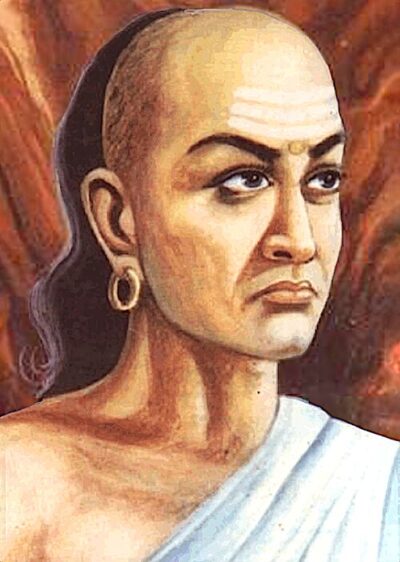
Arthashastra
Arthashastra is an ancient Indian treatise by Kautilya. It was written by Chanakya.
- Published
- 3rd century BC
- Written by
- Chanakya
All 4 facts, and where they come from
Facts
4 facts · 0 confirmed by two sources · 0 cited · 4 from one source
Where this comes from
Papalocal keeps its own record. It started from these sources; what each one said is kept here as it was copied, so a change on their side never changes this page by itself. Tap one to read its version.
What Wikidata says · copied November 17, 2026 · revision 2541692623
- Described as
- ancient Indian treatise by Kautilya
- Other names
- the Arthashastra
- What it is
- literary work
- Written by
- Chanakya
- Published
- 3rd century BC
- Language
- Sanskrit · 1 reference
- Wikipedias with a page
- 53
Wikidata item Q323133 (wikidata.org/wiki/Q323133), public domain (CC0). Copied 2026-11-17.
What Wikipedia says · copied November 17, 2026 · revision 1386038145
Kautilya's Arthashastra (IAST: Kauṭilyam Arthaśāstram; transl. Kautilya's compendium on worldly affairs) is an Ancient Indian Sanskrit treatise on statecraft, politics, economic policy and military strategy. The text is likely the work of several authors over centuries, starting as a compilation of Arthashastras, texts which according to Olivelle date from the 2nd c. BCE to the 1st c. CE. These earlier treatises were compiled and amended in a new treatise, according to McClish and Olivelle in the 1st century CE by either an anonymous author or Kautilya, though earlier and later dates have also been proposed. While often regarded as created by a single author, McClish and Olivelle argue that this compilation, possibly titled Daņdanīti, served as the basis for a major expansion and redaction in the 2nd or 3rd century CE by either Kautilya or an anonymous author, when several books, dialogical comments, and the disharmonious chapter-division were added, and a stronger Brahmanical ideology was brought in. The text thus became a proper arthashastra, and was retitled to Kautilya's Arthashastra.
Two names for the text's compilor or redactor are used in the text, Kauṭalya (Kautilya) and Vishnugupta. Chanakya (375–283 BCE), the legendary counsellor of Chandragupta Maurya, is implied in a later interpolation, reinforced by Gupta-era and medieval traditions, which explicitly identified Kautilya with Chanakya. This identification started during the Gupta reign (c. 240 – c. 579), strengthening the Gupta's ideological presentation as heirs of the Mauryas. However, the identification has been questioned by scholarship, and rejected by the main studies on the topic since 1965, because of stylistic differences within the text which point to multiple authorship, as well as historical elements which are anachronistic for the Mauryan period, but fit in the first centuries of the Common Era. The Arthashastra was influential until the 12th century, when it disappeared. It was rediscovered in 1905 by R. Shamasastry, who published it in 1909. The first English translation, also by Shamasastry, was published in 1915.
The Sanskrit title, Arthashastra, can be translated as 'treatise on "political science"' or "economic science" or simply "statecraft", as the word artha (अर्थ) is polysemous in Sanskrit; the word has a broad scope. It includes books on the nature of government, law, civil and criminal court systems, ethics, economics, markets and trade, the methods for screening ministers, diplomacy, theories on war, nature of peace, and the duties and obligations of a king. The text incorporates Hindu philosophy, includes ancient economic and cultural details on agriculture, mineralogy, mining and metals, animal husbandry, medicine, forests and wildlife.
The Arthashastra explores issues of social welfare, the collective ethics that hold a society together, advising the king that in times and in areas devastated by famine, epidemic and such acts of nature, or by war, he should initiate public projects such as creating irrigation waterways and building forts around major strategic holdings and towns and exempt taxes on those affected. The text was influenced by Hindu texts such as the sections on kings, governance and legal procedures included in Manusmriti.
From the Wikipedia article “Arthashastra” (en.wikipedia.org/wiki/Arthashastra), by its contributors, under CC BY-SA 4.0 (creativecommons.org/licenses/by-sa/4.0/). Copied 2026-11-17; not changed.
Confirmed Two sources agree. Cited One source, and it names where it got it. One source One source, without a reference of its own. Sources disagree The sources disagree. We show the best-supported value and keep theirs below.