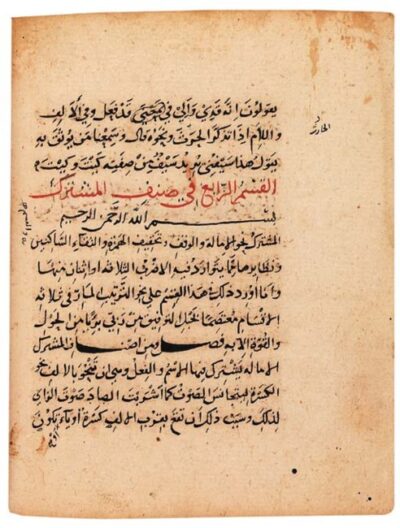
Asās al-balāghah
Asās al-balāghah is a book by al-Zamakhsharī.
- Written by
- Al-Zamakhshari
- Genre
- dictionary
All 6 facts, and where they come from
Facts
6 facts · 0 confirmed by two sources · 0 cited · 6 from one source
Where this comes from
Papalocal keeps its own record. It started from these sources; what each one said is kept here as it was copied, so a change on their side never changes this page by itself. Tap one to read its version.
What Wikidata says · copied November 17, 2026 · revision 2470621408
- Described as
- book by al-Zamakhsharī
- What it is
- dictionary of the Arabic language; literary work; written work
- Written by
- Al-Zamakhshari
- Genre
- dictionary · 1 reference
- Language
- Arabic · 1 reference
- Wikipedias with a page
- 9
Wikidata item Q19418881 (wikidata.org/wiki/Q19418881), public domain (CC0). Copied 2026-11-17.
What Wikipedia says · copied November 17, 2026 · revision 1384421175
Asās al-Balāghah ("The Foundation of Eloquence") is a thesaurus and dictionary of figurative speech (Ilm al-Bayan), a branch in Arabic rhetoric authored by Al-Zamakhshari. Zamakhshari authored the work, in part, to reconcile what he viewed as the miraculous nature of the Qur'an with his theological views.
Notable as the earliest fully alphabetical Arabic lexicography, and in addition for the metaphorical content Zamakhshari includes with his literal definitions. Zamakhshari's system lists words in alphabetical order according to the first component of their tri-radical consonant letters to the last. He excludes complicated derived and rare forms, such quadrilaterals and quintilaterals. Zamakhshari's goal was to catalog both the literal and figurative meanings of Arabic words, and he used examples from the Qur'an and hadith for both. He viewed words almost as living organisms that were given life by the way they were used in rhetoric.
From the Wikipedia article “Asas al-Balagha” (en.wikipedia.org/wiki/Asas_al-Balagha), by its contributors, under CC BY-SA 4.0 (creativecommons.org/licenses/by-sa/4.0/). Copied 2026-11-17; not changed.
Confirmed Two sources agree. Cited One source, and it names where it got it. One source One source, without a reference of its own. Sources disagree The sources disagree. We show the best-supported value and keep theirs below.