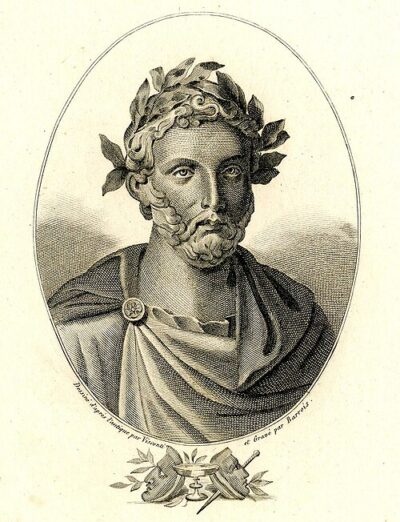
Asinaria
Asinaria is an Ancient Roman play by Plautus.
- Written by
- Plautus
- Genre
- fabula palliata
All 4 facts, and where they come from
Facts
4 facts · 0 confirmed by two sources · 2 cited · 2 from one source
Where this comes from
Papalocal keeps its own record. It started from these sources; what each one said is kept here as it was copied, so a change on their side never changes this page by itself. Tap one to read its version.
What Wikidata says · copied November 17, 2026 · revision 2567914535
- Described as
- Ancient Roman play by Plautus
- Other names
- Pl. As.
- What it is
- literary work
- Written by
- Plautus · 1 reference
- Genre
- fabula palliata
- Language
- Latin · 1 reference
- Wikipedias with a page
- 12
Wikidata item Q669022 (wikidata.org/wiki/Q669022), public domain (CC0). Copied 2026-11-17.
What Wikipedia says · copied November 17, 2026 · revision 1337671749
Asinaria ("The Comedy of Asses") is a comic play written in Latin by the Roman playwright Titus Maccius Plautus. In the play an Athenian gentleman, Demaenetus, tells his slave Libanus that he knows his son Argyrippus is having an affair with the prostitute Philaenium next door, and he asks him to try to find some money to pay for the affair. When by chance a stranger comes bringing money owed for some donkeys sold by Saurea, the steward of Demaenetus's wife, Libanus's fellow-slave Leonida pretends to be Saurea, and the two slaves trick the stranger into giving them the money. Argyrippus is given the money on condition that his father is to be allowed to enjoy the first night with the prostitute. But a jealous rival, Diabolus, snitches on Demaenetus to his wife Artemona, who storms to the brothel and prevents her husband from enjoying the girl as well.
The title Asinaria is short for asinaria fabula "the play about donkeys". Similar titles ending in the suffix -aria are found the plays Aulularia, Cistellaria, Mostellaria and Vidularia.
In his edition, de Melo suggests that this is a relatively early play, partly because it has few polymetric cantica. Another indication is that in line 307 there is a probable reference to the velites "light-armed soldiers", a special force which was first officially introduced in 211 BC.
The play is famous for containing the lines Lupus est homo homini, non homo, quom qualis sit non novit which has been translated as "A man is a wolf rather than a man to another man, when he hasn't yet found out what he's like"; facias ipse quod faciamus nobis suades "Practice yourself what you preach"; and necesse est facere sumptum qui quaerit lucrum "You must spend money to make money."
From the Wikipedia article “Asinaria” (en.wikipedia.org/wiki/Asinaria), by its contributors, under CC BY-SA 4.0 (creativecommons.org/licenses/by-sa/4.0/). Copied 2026-11-17; not changed.
Confirmed Two sources agree. Cited One source, and it names where it got it. One source One source, without a reference of its own. Sources disagree The sources disagree. We show the best-supported value and keep theirs below.