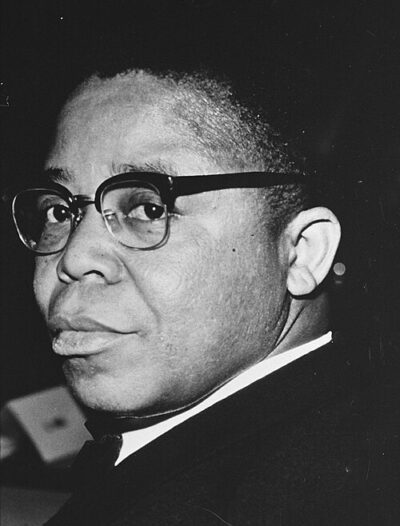
Bakongo Alliance
The Bakongo Alliance is a political party in the Democratic Republic of the Congo. It was founded in 1950. Its headquarters are in Kinshasa. It stands for liberal conservatism.
- Country
- Belgian Congo (1950–1960)
- Founded
- 1950
- Ideology
- liberal conservatism
All 9 facts, and where they come from
Facts
9 facts · 0 confirmed by two sources · 5 cited · 4 from one source
Where this comes from
Papalocal keeps its own record. It started from these sources; what each one said is kept here as it was copied, so a change on their side never changes this page by itself. Tap one to read its version.
What Wikidata says · copied November 17, 2026 · revision 2556545028
- Described as
- political party in the Democratic Republic of the Congo
- What it is
- political party (1959–1965) · 1 reference; non-governmental organization (1950–1959) · 1 reference
- Founded
- 1950 · 1 reference
- Ended
- 1965 · 1 reference
- Headquarters
- Kinshasa · 1 reference
- Country
- Belgian Congo (1950–1960); Republic of the Congo (Léopoldville) (1960–1965)
- Chair
- Joseph Kasa-Vubu (1955–1965) · 1 reference
- Ideology
- liberal conservatism
- Wikipedias with a page
- 10
Wikidata item Q1666735 (wikidata.org/wiki/Q1666735), public domain (CC0). Copied 2026-11-17.
What Wikipedia says · copied November 17, 2026 · revision 1379065170
The Bakongo Association for the Unification, Conservation and Development of the Kongo Language (French: Association Bakongo pour l'unification, la conservation et le développement de la langue Kongo, ABAKO) was a Congolese political party founded in 1950 by Edmond Nzeza Nlandu in Léopoldville. It subsequently came to be headed by Joseph Kasa-Vubu, and emerged in the late 1950s as a vocal opponent of Belgian colonial rule in what is today the Democratic Republic of the Congo. In addition to its political role, ABAKO served as the principal ethno-religious organisation for the Kongo people (also known as Bakongo) and became closely intertwined with the Kimbanguist Church, which was extremely popular in the Lower Congo region.
From the Wikipedia article “ABAKO” (en.wikipedia.org/wiki/ABAKO), by its contributors, under CC BY-SA 4.0 (creativecommons.org/licenses/by-sa/4.0/). Copied 2026-11-17; not changed.
Confirmed Two sources agree. Cited One source, and it names where it got it. One source One source, without a reference of its own. Sources disagree The sources disagree. We show the best-supported value and keep theirs below.