Banderia Prutenorum
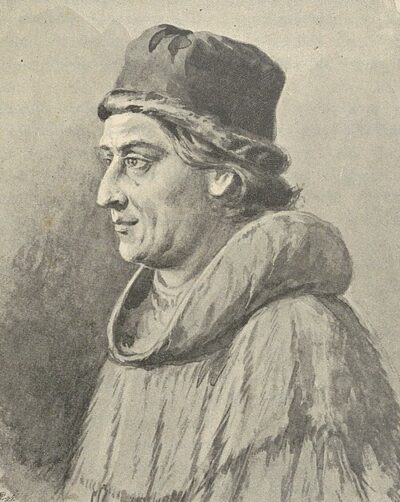
Banderia Prutenorum is an illuminated manuscript. It came out in 1448. It was written by Jan Długosz.
- Released
- 1448
- Came out
- 1448
- Written by
- Jan Długosz
- Country of origin
- Poland
All 6 facts, and where they come from
Facts
6 facts · 0 confirmed by two sources · 0 cited · 6 from one source
Where this comes from
Papalocal keeps its own record. It started from these sources; what each one said is kept here as it was copied, so a change on their side never changes this page by itself. Tap one to read its version.
What Wikidata says · copied November 17, 2026 · revision 2502226396
- What it is
- illuminated manuscript
- Written by
- Jan Długosz
- Released
- 1448
- Language
- Latin
- Country of origin
- Poland
- Came out
- 1448
- Wikipedias with a page
- 11
Wikidata item Q636825 (wikidata.org/wiki/Q636825), public domain (CC0). Copied 2026-11-17.
What Wikipedia says · copied November 17, 2026 · revision 1384745232
The Banderia Prutenorum is a manuscript of 48 parchment sheets, 18.6 by 29.3 cm (7.3 by 11.5 inches), composed by Jan Długosz and illuminated by Stanisław Durink, listing 56 vexillae, or banners, of the Order of the Teutonic Knights. The title means Blazons of the Prussians. Prutenorum is the genitive plural of Pruteni, Prussians.
In Polish the name is Chorągwie Pruskie. Chorągwie can mean banner, standard, or regiment. The heraldic term blazon in English is probably the exact meaning.
From the Wikipedia article “Banderia Prutenorum” (en.wikipedia.org/wiki/Banderia_Prutenorum), by its contributors, under CC BY-SA 4.0 (creativecommons.org/licenses/by-sa/4.0/). Copied 2026-11-17; not changed.
Confirmed Two sources agree. Cited One source, and it names where it got it. One source One source, without a reference of its own. Sources disagree The sources disagree. We show the best-supported value and keep theirs below.